
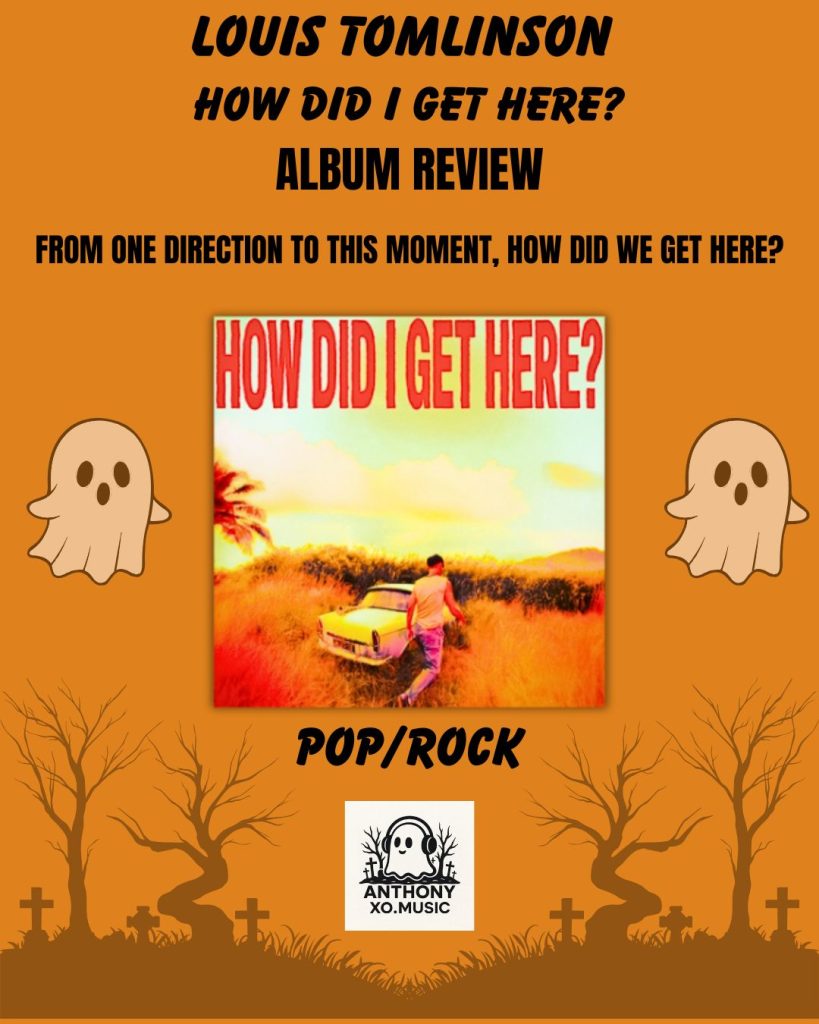
Louis Tomlinson- How Did I Get Here? (Album Review)
Hi everyone. It’s Anthony Stirford from Anthony XO.Music. I’m here today with a review of the new Louis Tomlinson album, How Did I Get Here? Former One Direction member Louis Tomlinson left the group in 2016 and later joined The X Factor as a permanent judge. In 2017, he released his breakthrough solo single “Back To You” in collaboration with Bebe Rexha, which was the first moment his solo career really caught mainstream attention. In 2020, Tomlinson dropped his debut album Walls, which received mixed reviews from outlets like Pitchfork and Rolling Stone, though critics consistently praised his songwriting ability.
In 2022, he returned with his second album Faith In The Future, which was received far more positively. The album was praised for its sonic cohesion, drawing heavily from Britpop and indie rock influences. Tracks like “The Greatest,” “Silver Tongue,” and “Chicago” stood out for their assured, electric sound. Across his first two albums, Tomlinson earned recognition for leaning into indie rock–influenced production while still carrying clear traces of his One Direction era. Indie rock, Britpop, and pop-punk textures were always present, but his vocals felt more evolved, carrying more emotional weight and maturity.
Now in 2026, Tomlinson is back with a new album, and while the sound remains familiar, it feels more refined. How Did I Get Here? continues his preference for introspective songwriting and nostalgic, guitar-driven production. This time, though, the writing feels noticeably more mature, with moments that reflect on personal loss and growth, including references to his former friend Liam Payne. I felt this album sounds glossier than his previous projects, and the songwriting is clearly his most self-aware yet. Where his earlier albums were rooted heavily in grief, this one feels like a signal toward a brighter, sunnier direction.
Back in September 2025, Tomlinson released the single “Lemonade,” inspired by San Teresa, Costa Rica, and it immediately signaled this shift in tone. I really love “Lemonade” because of how energetic it feels, especially in the chorus. The production is full of groovy guitars, thumping percussion, and slightly messy psychedelic touches. The chorus is pure nostalgia and honestly undeniable. Overall, the song feels exactly like its title, refreshing and vibrant, which is why it earns a strong 4.5 out of 5, leaning toward a light 5.
“On Fire” continues that uplifting, energetic momentum. The production here is sleek and polished, and I’m genuinely impressed by Tomlinson’s use of falsetto, which adds a new texture to his vocals. The lyrics work well, but the chorus doesn’t fully hit for me the way I wanted it to. Still, it feels like an arena-ready track, so I’m giving it a solid 4 out of 5.
The album’s second lead single, “Palaces,” blends indie rock with radio-friendly pop and comes across as another stadium-sized anthem. The production is nostalgic and groovy, clearly reminiscent of early 2000s Britpop. I love Tomlinson’s energetic vocal delivery here, and the lyrics are strong across the board. The introspective songwriting really shines, making this one of the album’s clearest highlights. I’d give “Palaces” a confident 4.5 out of 5.
The sixth track, “Last Night,” is a melancholic banger built around a very atmospheric sound. It leans into balladry and moody indie textures, and to me it strongly recalls the One Direction era. That influence is still very present in Tomlinson’s music. While I think “Last Night” is a solid highlight, I hesitate to call it a full standout because it doesn’t linger with me as much as some of the stronger tracks. I’m giving it a 4 out of 5.
“Dark To Light,” the eighth track, blends soft rock with psychedelic and funky elements. Lyrically, this is one of the strongest moments on the album. Tomlinson directly addresses his former bandmate and friend Liam Payne here, which adds emotional weight and depth. His vulnerable vocal performance really works, making it a meaningful highlight, even if it doesn’t fully explode sonically. I’d give this one a solid 3.5 out of 5.
“Imposter” is probably the most introspective and sonically unique track on the album. The production leans into cool alt-pop and indie-pop territory, and it actually reminds me of sombr’s “12 To 12.” I really like the atmospheric feel and the inward-looking vocal performance here. It’s not a huge moment, but it’s effective, which is why I’m landing at a strong 3.5 out of 5, edging toward a light 4.
While How Did I Get Here? is packed with strong moments, it does stumble a bit in the middle with a few tracks that feel less essential. “Sunflowers,” “Lazy,” and “Lucid” aren’t bad songs by any means, but they feel disconnected from the album’s core energy. The project thrives on uplifting, energetic guitar-driven tracks, and these slower cuts disrupt that flow rather than expand it. They don’t add new emotional layers or sonic ideas, which makes them feel more like padding than purposeful transitions, and that’s where the album loses some momentum.
Overall, How Did I Get Here? is filled with highlights like “Lemonade,” “Palaces,” “Last Night,” and “On Fire.” I really enjoy the production, which leans heavily into nostalgic indie rock while maintaining an uplifting tone. Compared to Tomlinson’s earlier albums, this is one of his most cohesive projects in terms of sound and direction. The songwriting remains introspective but feels more mature and reflective. In the end, I think How Did I Get Here? is a very good album, even if it stops short of being truly great.
Rating: 7/10
How Did I Get Here Tier List:
- Great- Lemonade and Palaces
- Perfect- On Fire, Last Night, and Imposter
- Good- Dark To Light
- Average- Sunflowers, Lazy, Broken Bones, Sanity, and Jump The Gun
- Worst- Lucid