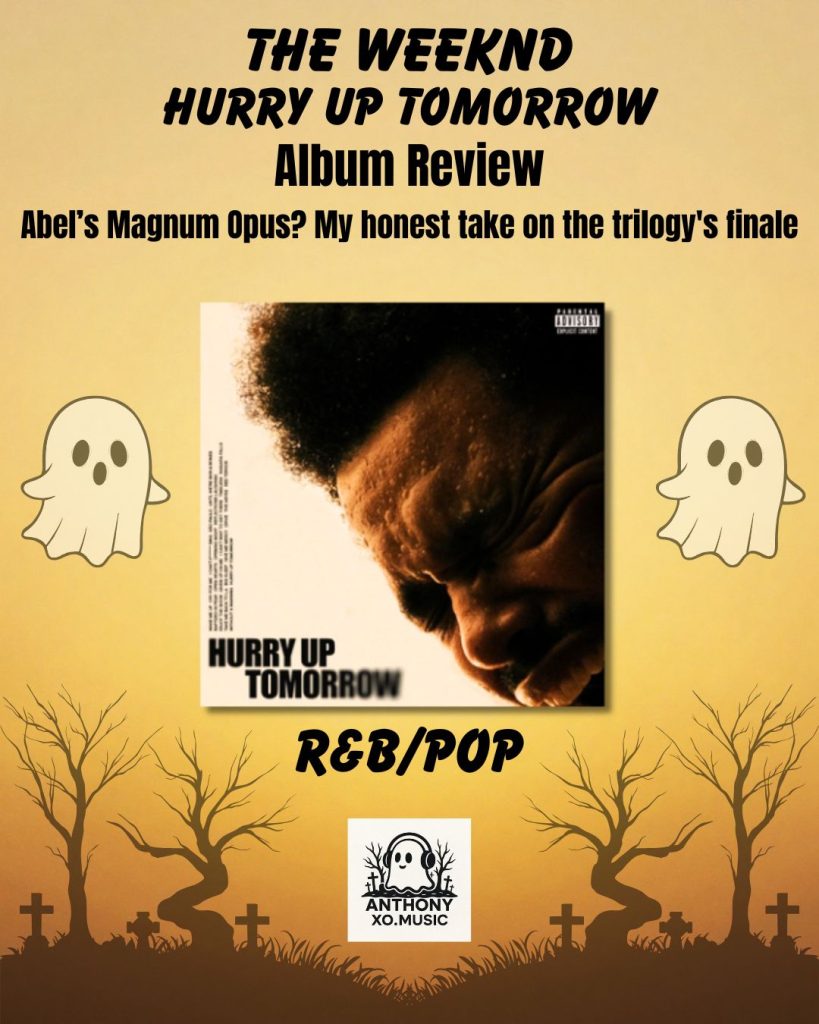
Hi everyone. This is Anthony Stirford, and I’m back with a review of The Weeknd’s sixth studio album, Hurry Up Tomorrow.
One of the most streamed artists in the world, The Weeknd, born Abel Makkonen Tesfaye, released Hurry Up Tomorrow on January 31, 2025. The album serves as the third and final installment of the trilogy that began with 2020’s After Hours and continued with 2022’s Dawn FM. More importantly, it stands as the final project released under the iconic stage name “The Weeknd,” giving the record an added sense of weight and finality.
Tesfaye launched this trilogy with After Hours, a career-defining album that marked a creative and commercial peak. It earned him multiple awards, massive chart success, and the prestigious Super Bowl Halftime Show performance. Critics praised After Hours for its cohesive production, cinematic visuals, and emotional clarity, solidifying it as one of the most important pop albums of the decade.
In 2022, he followed it with Dawn FM, an album framed as a ghostly radio broadcast drifting between life and death. Drawing heavily from 1980s synth-pop and Japanese dance-pop influences, Dawn FM refined The Weeknd’s darker instincts into a sleek, conceptual package. While divisive among casual listeners, it was widely respected for its ambition and world-building.
Three years later, Hurry Up Tomorrow arrives as the trilogy’s conclusion, sprawling across 22 tracks. It is a long, immersive listen, and its scale immediately signals that Tesfaye is aiming for something reflective rather than explosive. As his final release under this persona, the album feels less like a victory lap and more like a confession.
Sonically, Hurry Up Tomorrow continues the palette established by its predecessors, leaning heavily into synth-pop, alternative pop, and atmospheric R&B. However, the emotional tone is noticeably heavier. The album often feels like a man reckoning with his past, confessing sins before the end of an era. Early concepts suggested a focus on the afterlife, but the finished record feels more grounded in regret, guilt, and self-examination. It is ethereal and hazy, but also dense and introspective.
The production across Hurry Up Tomorrow is tightly focused despite its length. A wide range of high-profile producers contribute, including Max Martin, Metro Boomin, Oscar Holter, Daniel Lopatin, Pharrell Williams, Giorgio Moroder, and Justice. Rather than feeling scattered, their involvement helps shape a cohesive soundscape built around glossy synths, reverberated drums, and cinematic arrangements.
Thematically, the album dives deep into self-reflection, pain, guilt, trauma, and anxiety. These themes are not new to The Weeknd’s catalog, but here they are presented with less dramatization and more vulnerability. The persona feels stripped back, almost weary, as if Tesfaye is ready to close this chapter of his career for good.
The album opens with “Wake Me Up,” a track clearly inspired by Michael Jackson’s Thriller era, featuring Justice. Structurally, it unfolds in two distinct movements. The first half builds with ethereal orchestral strings and haunting vocals, while the second shifts into a disco-driven groove with brighter melodies. The production work from Justice, Mike Dean, and Daniel Lopatin gives the song a sharp, polished edge. As an opener, it successfully establishes the album’s atmosphere, though its extended runtime slightly undercuts its memorability. It is a strong introduction, even if it doesn’t fully ignite. Rating: 4/5.
“Cry For Me,” the album’s second track, is one of its most immediate standouts. Funky, energetic, cinematic, and emotionally charged, the song thrives on its vibrant bassline, electric guitar flourishes, and shimmering synths. Rooted in an 80s dance-pop aesthetic, it reinforces the album’s sonic foundation while injecting momentum. It sets a confident tone for what follows and stands as one of Hurry Up Tomorrow’s highlights. Rating: 5/5.
Following a brief interlude, “Sao Paulo” arrives as a Brazilian funk-inspired track featuring Anitta. While energetic and well-executed, its stylistic direction raises questions about its placement. The album’s sonic universe is largely ethereal and introspective, and “Sao Paulo” feels somewhat detached from that emotional core. Both Anitta and Tesfaye deliver strong performances, and the track is enjoyable on its own, but its relevance within the album’s narrative is debatable. As a standalone song it works, though it slightly disrupts the flow. Rating: 4/5.
After another interlude, “Baptized In Fear” emerges as the album’s first deeply confessional moment. Ethereal, hazy, painful, and nihilistic, it captures the emotional essence of Hurry Up Tomorrow. The production leans into distorted synths, heavy drum loops, and dense reverb, giving the track a claustrophobic intensity. Tesfaye’s vulnerability is striking here, even if the song itself isn’t immediately memorable. Still, its emotional weight makes it a clear highlight. Rating: 4/5.
“Open Hearts” follows as one of the album’s emotional peaks. Lyrically, it explores heartbreak, regret, and emotional surrender. Sonically, it blends balladic synth-pop with influences from arena rock and gospel. Sleekly produced by Max Martin, Mike Dean, and Oscar Holter, the track relies on layered synthesizers, restrained drums, and subtle guitar work. It feels expansive without being overwhelming and functions as the album’s emotional centerpiece. Rating: 4.5/5.
“Opening Night” and “Reflections Laughing” serve as reflective mid-album pieces that extend the mood established by “Open Hearts.” “Opening Night” works as a brief, introspective interlude, while “Reflections Laughing” offers a more developed narrative moment. Tesfaye delivers restrained, almost spoken vocals, detailing personal struggles. Travis Scott’s appearance is understated but effective, and additional contributions from Florence + The Machine and Chxrry22 add texture. While not standout tracks, they provide necessary breathing room within the album’s structure. Rating: 3.5/5.
“Enjoy The Show” and “Given Up On Me” represent the album’s weakest stretch. “Enjoy The Show,” featuring Future, shows promise in its concept, particularly with Future’s melodic rather than rap-focused contribution. However, the track feels overlong and lacks the slow-burn payoff present in earlier songs. Its ideas never fully coalesce, resulting in a bloated, middling experience. Rating: 2.5/5.
“Given Up On Me” fares slightly better, opening with intensity before losing momentum in its latter half. The contrast between its strong beginning and subdued ending prevents it from fully resonating, leaving it serviceable but unremarkable. Rating: 3/5.
“I Can’t Wait To Get There” arrives as a melodic reset. A slow-burning R&B ballad with gospel undertones, it highlights Tesfaye’s vocal softness and emotional restraint. The production is warm and minimal, allowing the melody to breathe. While not a major standout, it is a pleasant and effective moment within the album’s pacing. Rating: 3.5/5.
“Timeless,” which follows, is one of the album’s most popular tracks. A trip-hop and R&B hybrid that dominated streaming upon its release in September 2024, the song presents another stylistic detour. Like “Sao Paulo,” its placement can feel questionable, yet hip-hop-influenced tracks have historically played similar roles in The Weeknd’s albums. Playboi Carti delivers an impressive opening verse, and the production from Pharrell Williams, Mike Dean, Ojivolta, and Twisco blends staggered trap drums with deep bass and melodic flourishes. Even if it slightly disrupts the album’s emotional continuity, its musical strength is undeniable. Rating: 5/5.
“Niagara Falls” stands out as a cinematic blend of synth-pop and alternative R&B. Sweeping pads, mid-tempo drum programming, and subtle water-textured effects create an immersive soundscape that mirrors its title. It is one of the album’s most atmospheric tracks and a clear highlight. Rating: 4/5.
“Take Me Back To LA” and “Big Sleep” are among the album’s most overlooked moments. Both tracks balance nostalgia and futurism, echoing the emotional tones of After Hours and Dawn FM. While they have received limited attention, their contributions to the album’s emotional arc are significant, reinforcing the project’s reflective nature.
Similarly, “Give Me Mercy” and “Drive” are understated but effective. These tracks lean into psychological introspection and complement the visual aesthetic associated with the Hurry Up Tomorrow film. They may not stand out individually, but they add warmth and cohesion to the album’s latter half.
“The Abyss,” featuring Lana Del Rey, is one of the album’s defining moments. Psychologically heavy and emotionally intense, the track ventures into progressive electronic and industrial R&B territory. Tesfaye delivers one of his most vulnerable performances, while Del Rey’s contribution adds a haunting, celestial quality. Together, they create a sonic and emotional centerpiece that feels essential. Rating: 5/5.
“Red Terror” follows with an experimental approach, reflecting on themes connected to Ethiopia’s history. Its poetic vocal delivery and unconventional production make it compelling, even if it lacks mainstream appeal. It functions more as an artistic statement than a crowd-pleaser. Rating: 3/5.
“Without A Warning,” the penultimate track, returns to an ethereal sound. Blending dark trap, psychedelia, and electronic rock, the song thrives on atmosphere and emotional tension. Tesfaye’s vocals feel distant yet intimate, reinforcing the album’s closing mood. Rating: 3.5/5.
The album concludes with its title track, “Hurry Up Tomorrow,” a powerful and fitting finale. Drawing heavily from gospel, orchestral, and symphonic traditions, the song features choir arrangements, sweeping strings, layered synths, and a grounded rhythmic foundation. Lyrically and emotionally, it is confessional and spiritual, offering closure without grandiosity. As a closing statement, it stands among the strongest of Tesfaye’s career. Rating: 4.5/5.
As a whole, Hurry Up Tomorrow is experimental, emotional, and tightly focused despite its length. While it contains a few missteps and moments of excess, its highlights far outweigh its flaws. Nearly all of its tracks are at least engaging, and many are genuinely powerful. As the final chapter of this trilogy and the closing of an era, the album succeeds not by reinventing The Weeknd, but by allowing him to reflect, confess, and finally let go.
Overall Rating: 8/10
- Favorite Tracks: Cry For Me, The Abyss, Hurry Up Tomorrow, Niagara Falls, Open Hearts, Baptized In Fear, Timeless
- Least Favorite Tracks: Enjoy The Show