
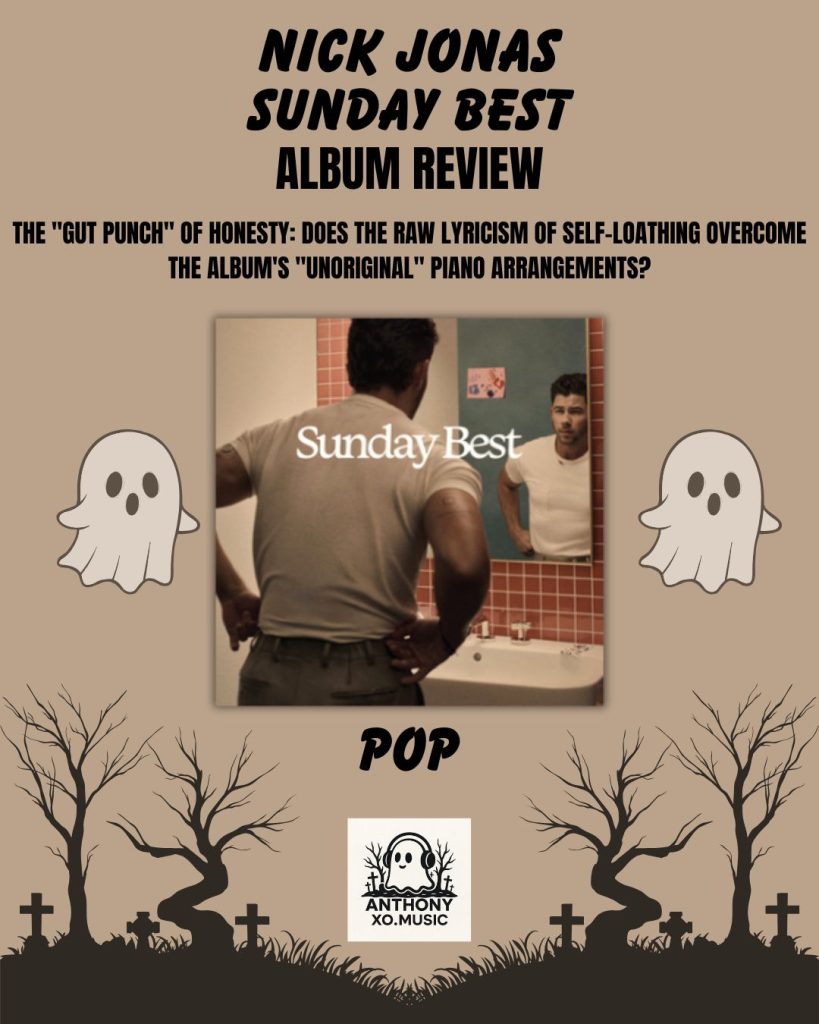
Hi everyone, it’s Anthony Striford from Anthony XO.Music, and today I’m reviewing Nick Jonas’s newest solo album, Sunday Best.
Nick Jonas has spent most of his life in the public eye. He began his career at a very young age alongside his brothers Kevin and Joe on the Disney Channel in the late 2000s. Since then, he has consistently released music both as part of the Jonas Brothers and as a solo artist. While his debut solo album arrived in 2004, it was 2014’s self-titled Nick Jonas that truly established him as a credible solo act. That record marked a turning point, proving he could step outside the band’s shadow and succeed on his own terms.
He followed it with Last Year Was Complicated in 2016, a project that showcased his ability to craft polished pop and R&B. With high-profile collaborations featuring Tove Lo, Ty Dolla $ign, and Big Sean, the album leaned heavily into sleek, radio-ready production. Tracks like “Close” became defining moments of his solo identity. In 2021, Spaceman expanded that identity further. It was refined, introspective, and cohesive. It did not rely on spectacle; instead, it focused on mood and reflection.
Now in 2026, Jonas returns with Sunday Best, an album positioned as a mature, reflective statement. The intention is clear: growth, perspective, and artistic control. The execution, however, tells a more complicated story.
Sunday Best presents itself as a polished pop record infused with soft rock, acoustic balladry, and contemporary R&B. From a production standpoint, it is immaculate. The drums snap with precision. The basslines glide effortlessly. Vocal harmonies are layered with technical perfection. Everything sounds expensive, carefully engineered, and strategically arranged. On a technical level, the album is impressive. But technical polish does not automatically translate into personality.
Lyrically, Jonas centers the album around devotion, self-assurance, romantic stability, and personal reflection. There is nothing inherently flawed about these themes. The issue lies in execution. The songwriting describes emotions rather than revealing them. Instead of sharp, specific storytelling, the lyrics rely on broad emotional statements. The result is an album that feels emotionally safe. It communicates feeling without fully exposing it.
The opening track, “Sweet To Me,” offers a gentle introduction. Built around warm instrumentation with subtle gospel undertones, it creates a comforting atmosphere. The production is controlled and elegant. It stands as one of the stronger tracks purely from a compositional standpoint. However, while the sound is refined, the lyrical depth never fully matches the sonic ambition.
“Gut Punch,” the fifth track, shifts into piano-driven territory. The arrangement is restrained, allowing Jonas’s vocals to take center stage. The chorus strongly echoes the cadence and melodic structure of James Arthur’s “Impossible,” particularly in its vocal phrasing. While the song is emotionally direct and technically polished, its familiarity weakens its impact. It aims for vulnerability but does not fully separate itself from its influences.
Several mid-album tracks, including “Handprints,” “I Need You,” “You Got Me,” and “Hope,” maintain consistency. They are cohesive, clean, and professionally executed. None of them collapse under weak production or poor performance. At the same time, none of them elevate the album. They function as stable entries in the tracklist rather than defining statements. The production remains smooth and reflective, but Jonas avoids risk. He sustains momentum without pushing boundaries. The result is competence without distinction.
“Seeing Ghosts” injects energy into the album. It leans into funk rock elements while retaining pop sensibilities. The track incorporates hints of New Orleans jazz, funk grooves, and soft rock textures. Musically, it stands apart from the surrounding material. Its rhythmic drive and genre-blending production make it the album’s most dynamic moment. There are faint echoes of the Jonas Brothers’ “Sucker” in its upbeat structure, but it carries enough individuality to avoid feeling derivative. Lyrically, it contrasts past struggles with present stability, giving the track emotional tension that much of the album lacks.
“Aphrodite” continues the pop and R&B fusion, presenting a sleek mid-tempo romantic anthem. The production is confident, tightly arranged, and modern. Here, Jonas experiments slightly more with rhythmic phrasing and melodic layering. The lyrics display more focus and emotional clarity than many surrounding tracks, making it one of the album’s stronger cuts.
“911” moves away from the album’s gospel-leaning warmth and shifts into adult contemporary territory. The instrumental palette is more restrained, and the theme of lingering memories from past relationships adds emotional weight. The production feels honest and direct. It stands out for its focus and tonal clarity.
“The Greatest,” featuring Kevin and Joe Jonas, functions as a mellow piano ballad. The vocal blend is smooth, and the chemistry between the brothers is natural. However, the performance lacks urgency. The track feels pleasant rather than powerful.
The album closes with “Princesses,” a piano-driven slow dance-pop record. It carries reflective themes but lacks the melodic strength or climactic build necessary to serve as a definitive closer. Instead of concluding the album with a bold emotional statement, it settles into a restrained fade.
If Sunday Best is intended to signal maturity, it succeeds in sounding controlled and professional. Jonas demonstrates discipline and technical precision throughout. However, if the album is meant to represent artistic evolution, it does not reach that threshold. There are flashes of personality and occasional genre shifts, but they remain contained within a carefully managed framework.
Ultimately, Sunday Best feels designed to maintain stability rather than challenge expectations. It is cohesive, polished, and competently performed. Yet it rarely surprises, rarely unsettles, and rarely demands repeated listening. For an artist with Jonas’s experience and platform, that restraint reads less like confidence and more like caution.
Rating: 5.25/10
- Favorite Tracks: Gut Punch, Sweet Home, Seeing Ghosts
- Least Favorite Tracks: Princesses