
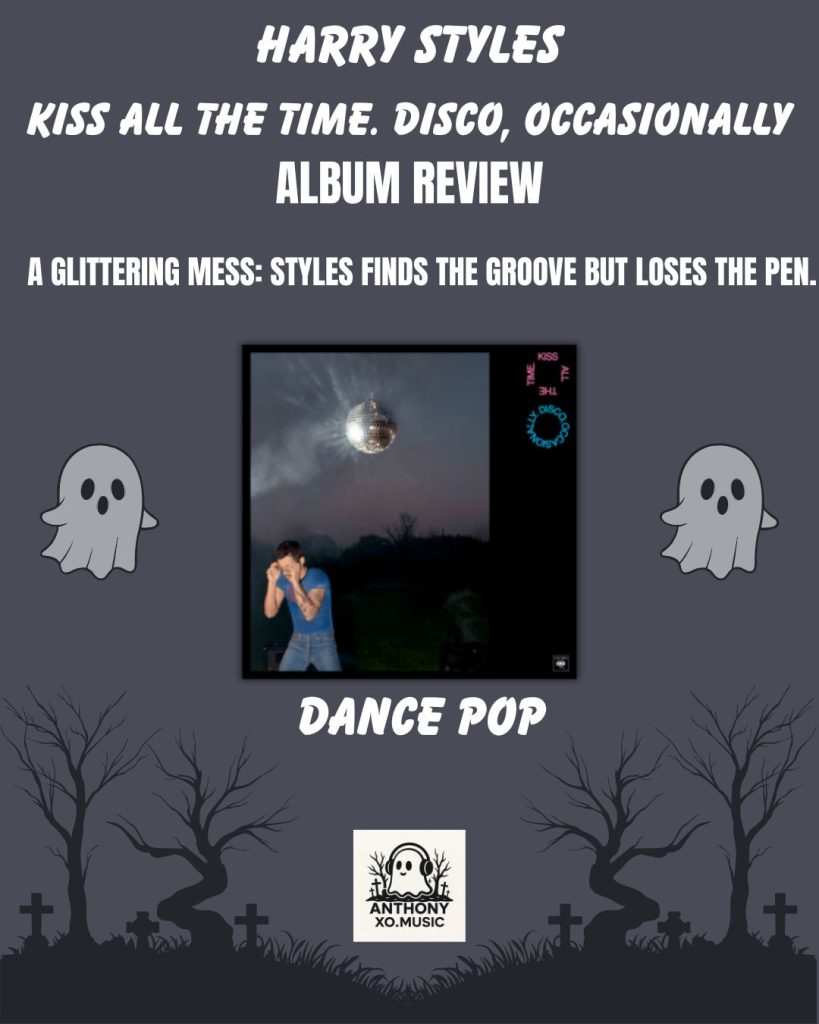
Harry Styles Kiss All The Time Disco Occasionally Album Review
Hi everyone, it’s Anthony Stirford here from Anthony XO.Music, and today I’m reviewing Kiss All The Time. Disco, Occasionally., the new album from Harry Styles.
Harry Styles Kiss All The Time Disco Occasionally Album Review: Disco Ambition vs Songwriting Consistency
When this record was announced, expectations were naturally pretty high. Harry has spent the last decade slowly building one of the most interesting solo careers to come out of a boy band era, and each album has pushed his sound a little further. Kiss All The Time. Disco, Occasionally. feels like another attempt to shift that direction again. The album leans heavily into disco energy and glossy electronic textures, but it still carries a lot of the emotional synth atmosphere that defined his last era.
Before getting into the record itself, it’s worth stepping back for a moment and looking at how Harry actually got here.
Harry Styles first stepped into global fame as part of One Direction, one of the most defining pop groups of the 2010s. That period made him a superstar, but it also left him with a pretty obvious challenge once the group went on hiatus. He had to prove that he could stand on his own artistically and not just exist as a former boy band member trying to extend his fame.
His solo career has really been that journey in slow motion.
The 2017 debut album, Harry Styles, was not a bad record at all, but it definitely felt like an artist still figuring things out. The album had some genuinely strong moments. “Sign of the Times” is still one of the best songs he has ever released, and tracks like “Kiwi” had a lot of personality. But the production often felt pretty raw and not fully polished. Outside of those highlights, there were quite a few filler tracks that kept the album from feeling completely focused.
It introduced Harry as a solo artist, but it did not fully define him yet.
Then came Fine Line, which honestly felt like a massive step forward. The production across that album was far more polished than the debut, and the songwriting felt sharper from start to finish. What impressed me most about Fine Line was its consistency. The first album had a noticeable amount of filler, but this one had almost none. The first six tracks alone are some of the strongest songs Harry has ever released. I genuinely love all of them and they feel like career defining moments for him as a songwriter and performer.
The only moment on that record that still feels raw production wise is “Cherry,” where the acoustic guitar really carries the entire track. But that rawness actually works in its favor. Everything else on the album is extremely polished.
By the time he reached Harry’s House, the production evolved again. After the sunshine pop and pop rock textures of Fine Line, this album leaned into a laid back palette built around 80s style synth pop and emotional electronic sounds. You hear that especially on songs like “As It Was,” “Matilda,” and “Satellite.” That record showed clear growth in Harry’s career without feeling forced or artificial. It was confident, stylish, and filled with iconic songs. The only track that ever felt like filler to me was “Boyfriends,” which I honestly find pretty boring and forgettable. Other than that, it was a very strong step forward for him.
So naturally the big question going into Kiss All The Time. Disco, Occasionally. was simple.
Where does he go next?
This new album clearly builds off the electronic foundation of Harry’s House, but it pushes things further into dance territory. Disco rhythms, shimmering synths, and high speed electronic grooves dominate the sound of the record. It is easily the most dance focused project Harry has ever released.
Production wise, this album sits in a strange middle ground for me. When the dance wave sound really hits, it sounds fantastic. The synth textures shimmer, the rhythms move fast, and the whole atmosphere feels energetic in a way Harry has not explored before. But the production is not quite as polished or bulletproof as what we heard on Fine Line or Harry’s House. It feels experimental at times, like the album is still searching for the perfect balance between disco excitement and emotional pop songwriting.
Sometimes that search works beautifully. Other times it feels slightly unfinished.
The songwriting is where the album starts losing some of its strength. It is not bad by any means, but it is not nearly as sharp as what Harry has shown in the past. There are flashes of great hooks and memorable lines, but there are also moments where the lyrics feel a little underwritten. Compared to the confident songwriting of Fine Line, this album sometimes feels like it is prioritizing the vibe more than the substance.
Vocally, Harry is a bit of a mixed bag here. On the faster disco inspired tracks he sounds lively and completely comfortable with the energy of the music. Those songs feel playful and exciting. But on some other tracks his performance feels oddly raw or slightly disengaged, almost like he is just drifting through the song rather than driving it forward.
The album opens with “Aperture,” and honestly it is one of the strongest moments on the entire record. The electronic textures here are fantastic. The chorus with the “We belong together” line is instantly catchy, and Harry sounds completely locked into the high speed production. It is glossy, energetic, and genuinely exciting.
“American Girls” follows with a sound that feels like a clear extension of the Harry’s House era. The chorus shimmers beautifully and the whole track has a smooth, polished glow. It may not be the biggest banger on the album, but it is still one of the best songs here.
“Ready, Steady, Go!” has some really satisfying dance pop production. The beat selection is strong and the groove is definitely there. But the songwriting and vocal performance do not quite match that energy. Harry’s delivery feels strangely childish and rough rather than playful.
“Are You Listening Yet?” works much better. The songwriting is sharper here and the dance heavy production feels purposeful rather than forced. It became a favorite for me pretty quickly.
“Taste Back” unfortunately slows things down in a way that kills some of the album’s early momentum. The songwriting is decent enough, but the vocal performance feels pretty bored and unenthusiastic.
Then comes “The Waiting Game,” which honestly feels like the most confusing song on the album. It does not really match the disco or dance pop identity the record is trying to build. The emotional tone is fine, but stylistically it feels like it belongs on a completely different project.
“Season 2 Weight Loss” finally pushes the energy back up again. The deep bassline is intense and Harry sounds far more confident here. It is one of the moments where the dance wave concept actually feels convincing.
“Coming Up Roses” leans into a softer romantic mood. The songwriting is genuinely solid, but the pacing is slow enough that it once again breaks the album’s momentum.
“Pop” is easily one of the biggest highlights. Harry’s performance is sharp, the synth pads shine, and the whole track creates this gleeful celebratory atmosphere that fits the disco concept perfectly. It is one of my favorites on the entire record.
“Dance No More” goes full disco, but surprisingly it does not explode the way it probably should. The idea is good, but the execution feels slightly underpowered.
“Pain By Numbers” brings back a bit of the raw guitar energy that reminds me of “Sign of the Times,” but it simply does not belong on an album that is supposed to revolve around disco and electronic dance sounds. It feels out of place and pretty lifeless.
The album closes with “Carla’s Song,” which actually works well as an ending. The slower pace suits the atmosphere of a final track, and Harry’s vocals feel more natural here than on some of the earlier songs.
Overall, Kiss All The Time. Disco, Occasionally. feels like an album caught between two ideas. The move toward disco and dance wave sounds is genuinely interesting, and when it works the results can be fantastic. Songs like “Aperture” and “Pop” prove that Harry can absolutely thrive in this kind of sonic environment.
But the album never fully commits to that identity. A few tracks feel disconnected from the core sound, and the songwriting is not as consistently strong as it was on his best records.
It is still a solid effort, and I respect the fact that Harry continues experimenting instead of repeating himself. But compared to the confidence and consistency of Fine Line and Harry’s House, this project lands somewhere in the middle.
There are great highs here, but also a few frustrating lows.
Rating: 6/10
- Favorite Tracks: Aperture, American Girls, Are You Listening Yet?, Pop, Carla’s Song
- Least Favorite Tracks: The Waiting Game, Taste Back, Pain By Numbers
Read my other posts: