
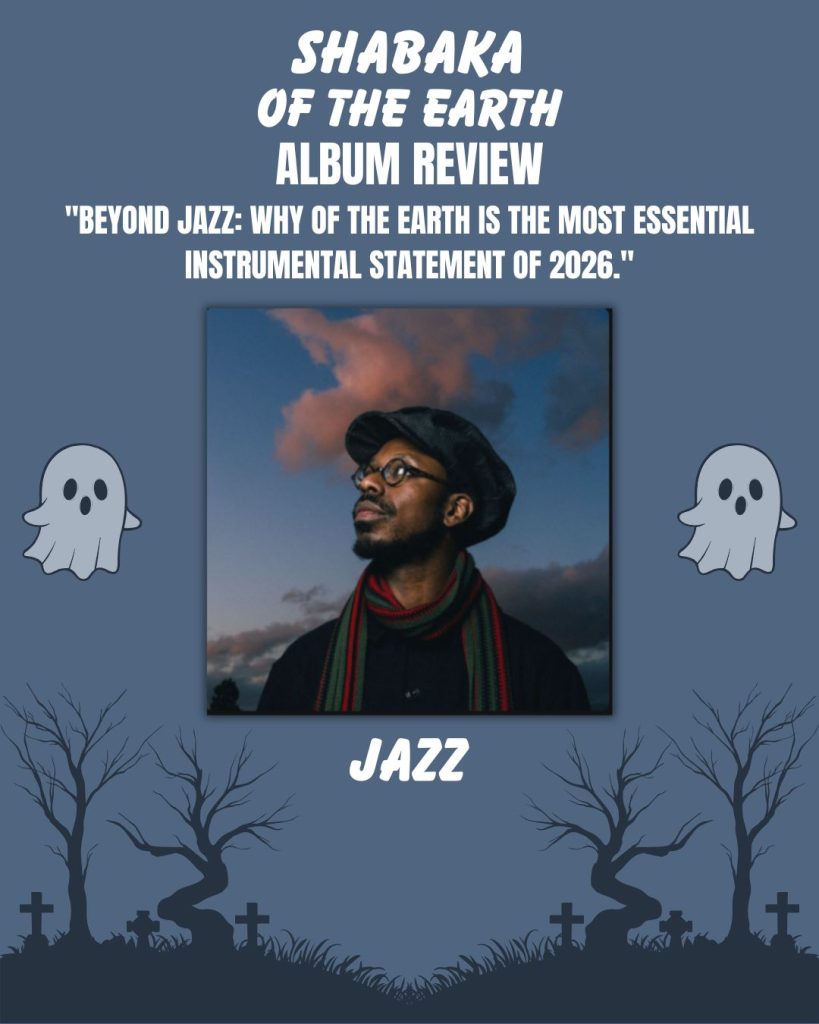
Shabaka- Of The Earth (Album Review): The Album That Redefined The Modern Jazz
Hi everyone, it’s Anthony Stirford here from Anthony XO.Music, and today I’m reviewing Of The Earth, the new album from Shabaka Hutchings, who now records simply as Shabaka.
There is a particular kind of tension that follows an artist who has already reshaped their genre once. Shabaka spent the better part of the last decade doing exactly that. He was not just participating in the modern British jazz explosion. In many ways, he was leading it. His work helped push the genre far beyond traditional boundaries and into something more urgent, more global, and much more rhythmically alive.
Then something surprising happened.
At the height of that reputation, he stepped away from the instrument most people associated with him. The saxophone disappeared from the center of his work and the flute became his primary voice. The shift was not just technical. It changed the emotional temperature of his music. The explosive, politically charged energy that defined his earlier groups gave way to something quieter and more meditative.
So coming into Of The Earth, the question is pretty simple. Was that stillness a destination, or was it just a transitional moment before another leap forward?
For me, this album answers that question very clearly.
Before diving into the record itself, it helps to look at the kind of career Shabaka has built. His reputation did not come from a single project or a single band. Instead, he spent years leading multiple groups that each explored a different corner of modern jazz.
One of those groups was Sons of Kemet, which became known for its explosive polyrhythms and politically charged energy. Their music blended Caribbean rhythms, jazz improvisation, and a raw sense of urgency that felt completely alive.
Then there was The Comet Is Coming, which pushed things in a completely different direction. That project leaned heavily into futuristic electronic textures and cosmic jazz energy. The music often felt like a collision between a rave and a jazz improvisation session.
And finally there was Shabaka and the Ancestors, which tapped into something deeper and more spiritual. That group drew heavily from South African jazz traditions and created music that felt communal, ceremonial, and emotionally grounded.
Across all three projects, Shabaka was not operating like a typical jazz bandleader. He was building full sonic worlds. His work pulled influences from the African diaspora, Caribbean culture, London’s modern electronic scenes, and the spiritual traditions that connect those histories together.
That foundation eventually led to his solo work.
His first solo record, Afrikan Culture, moved in a noticeably different direction. It leaned heavily into flute driven textures and explored a spiritual bridge between African traditions and Indian Vedic ideas. It had a ceremonial quality that could be genuinely beautiful, even if the music sometimes drifted into repetition.
Then came Perceive Its Beauty, Acknowledge Its Grace, which refined that concept significantly. The production was more polished and emotionally resonant. It felt less like an experiment and more like a fully realized statement about grace, meditation, and spiritual reflection.
After that, The Possession EP arrived with a few impressive collaborations, including appearances from billy woods and André 3000. The music was still beautiful, but it did not feel like a major step forward. It sounded like it belonged to the same world as the previous record rather than pushing the idea into new territory.
Shabaka Of The Earth Album Review – Best Tracks and Weak Moments
For the first time in a long while, it felt like Shabaka might be standing still.
That is exactly why Of The Earth feels so important.
Because this album immediately breaks that stillness.
Production wise, this record is one of the most varied things Shabaka has released in years. One of the criticisms that occasionally followed his earlier solo work was that the music could fall into repeating motifs. Certain textures and rhythms would circle back on themselves, creating a meditative atmosphere but sometimes limiting the sense of progression.
Of The Earth almost completely abandons that approach.
Instead, the album leans heavily into ancient African musical traditions while constantly shifting its rhythmic patterns and melodic structures. The tempo changes frequently. The percussion evolves from track to track. No two songs feel like they were built from the same template.
That alone makes the record feel far more alive than some of his recent work.
What makes the production even more exciting is the friction between worlds. Electronic dance textures appear throughout the album, and they are not just decorative elements. They actively interact with the acoustic instrumentation.
At times it feels like two musical languages are competing for control. Traditional jazz instrumentation and modern digital sound design collide with each other in a way that creates real tension.
And that tension works.
It feels like Shabaka is reconnecting the explosive energy of his earlier career with the spiritual focus of his solo work.
Instrumentally, his performance across the album is extremely confident. By this point, the decision to center his sound around the flute feels completely natural. What stands out most is the range he pulls from that instrument. Some passages feel delicate and reflective, while others carry real intensity.
The ensemble surrounding him also deserves a lot of credit. The rhythmic work throughout the record is incredibly dynamic. The percussion constantly shifts in tone and pace, giving the album a sense of movement that never feels static.
Now let’s talk about some of the best moments on the record.
Best Tracks
“A Future Untold” opens the album with an almost ceremonial atmosphere. It immediately signals that this record belongs to a different chapter of Shabaka’s work. The production carries some echoes of Perceive Its Beauty, Acknowledge Its Grace, but it also pushes forward with a sense of awakening.
“Step Lightly” might be one of the most exciting tracks in his entire catalog. The electronic dance textures push aggressively against the jazz instrumentation, and the result feels thrilling. It is the clearest example of how successfully this album blends traditional and modern sounds.
“Call The Power” is where the African influences really start to take shape. The rhythm is intense, the melodies feel culturally grounded, and the track pulls you deeper into the album’s sonic landscape.
“Dance In Praise” might be my personal favorite when it comes to pure energy. The rhythm here moves incredibly fast, but the variation keeps the track from ever feeling repetitive.
“Marwa The Mountain” is easily one of the most joyful moments on the entire record. The melodies are uplifting and the balance between ancient African sounds and jazz elements feels perfectly natural.
Weak Tracks
“Go Astray” and “Eyes Lowered” are not bad tracks at all, but they do not hit with the same force as the album’s strongest material. Because so much of the record thrives on intense rhythms and strong melodies, these slower moments feel slightly distracting rather than refreshing.
The closing track also feels a bit uneven. The vocal presence becomes stronger than the instrumental elements, and that balance feels slightly off on an album that is otherwise driven by powerful musicianship.
None of these moments ruin the experience, but they do slightly interrupt the momentum the album works so hard to build.
Overall, Of The Earth feels like a powerful reinvention for Shabaka. The repetitive textures that defined some of his earlier solo work have been replaced with faster rhythms, greater variation, and a much stronger connection to African musical traditions.
The friction between acoustic jazz instruments and modern electronic textures becomes the central idea of the album, and it works far more often than it fails.
A few moments slow the pacing slightly, and the closing track does not deliver the final punch the album probably deserves. But those are relatively small complaints compared to everything the record accomplishes.
When Of The Earth is at its best, it sounds unlike anything else happening in contemporary jazz.
And honestly, that is exactly what you want from an artist like Shabaka.
Rating: 9/10
- Favorite Tracks: A Future Untold, Call The Power, Dance In Praise, and Marwa The Mountain
- Least Favorite Tracks: Go Astray
Listen On Spotify:
Read My Other Posts: