
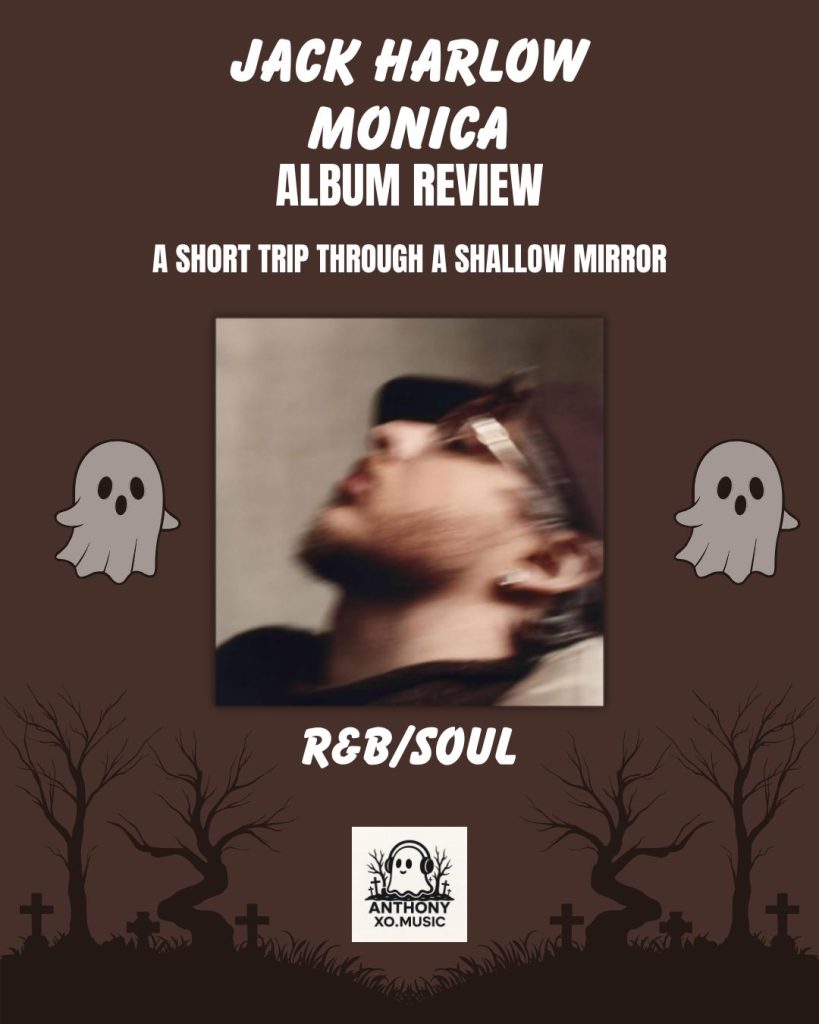
Jack Harlow Monica Album Review – Best Tracks and Weak Moments
Hi everyone, it’s Anthony Stirford here from Anthony XO.Music, and today I’m reviewing Monica, the latest album from Jack Harlow.
Jack Harlow Monica Album Review: Curated Minimalism vs Mainstream Expectation
For the past few years, Jack Harlow has navigated the rap world with a very specific kind of relaxed confidence. His style has rarely been about aggression or chaos. Instead, it leans toward smooth charisma, conversational flows, and mid-tempo beats that feel effortless rather than explosive. Most listeners know him through the massive viral energy of songs like “First Class” and the chart-smashing collaboration “Industry Baby.” Those tracks positioned him as a modern pop-rap star, someone capable of dominating streaming platforms and social media at the same time. But Monica feels like a deliberate step away from that loud formula. This album is not chasing viral energy or TikTok moments. Instead, it plays like a carefully restrained project where coolness matters more than spectacle. Harlow seems less interested in fighting for attention and more interested in curating a certain atmosphere. The record moves with patience and confidence, almost like he is deliberately lowering the volume of his career just to see what happens when listeners actually lean in.
Before getting deeper into the album itself, it helps to step back for a moment and look at how Jack Harlow reached this point. His career has always been tied to internet momentum. Early hype came from viral attention and digital buzz, but translating that kind of popularity into long-term hip-hop credibility has always been the real challenge. His 2020 debut album That’s What They All Say arrived with a lot of ambition behind it. The project clearly wanted to sound like a Gen Z rap statement rather than another copy of the worn-out 2010s trap formula. That ambition worked well online and helped fuel the hype surrounding his name, but the album itself didn’t fully satisfy critics. The opening stretch is actually very strong, but as the tracklist moves forward the style starts losing momentum. By the second half, Harlow’s persona feels slightly exposed and inconsistent. It wasn’t a bad record at all, but it felt like an artist still trying to figure out how to balance viral fame with a convincing artistic identity.
Then came Come Home the Kids Miss You, which felt like another ambitious swing, this time aimed squarely at the glossy world of pop-rap. The production on that album was far more polished, leaning heavily into shiny early-2000s aesthetics. From a sonic perspective it sounded expensive and carefully crafted. The main issue was the songwriting. In hip-hop, weak lyrics can quickly damage an artist’s credibility, and across that record the lyrical depth simply wasn’t strong enough to support the glossy sound. Another problem was variation. Harlow’s rapping style remained so similar from track to track that the album often felt repetitive. Even a huge hit like “First Class,” which became a social media phenomenon, relied more on trendy production than on particularly memorable writing.
The next chapter, Jackman., was where things finally started shifting in a more interesting direction. Instead of chasing massive chart moments, Harlow made a shorter and tighter project that focused more on rapping ability. The production leaned toward subtle retro textures, almost borrowing from 1960s pop influences in places. Without the distraction of oversized features or obvious filler songs, he actually sounded far more confident behind the microphone. The album wasn’t necessarily a masterpiece, but it clearly showed improvement. For the first time in his career, it felt like Jack Harlow was more interested in sharpening his craft than chasing algorithm-friendly success.
That evolution leads directly into Monica, his fourth album and arguably his most surprising pivot yet. Here Harlow moves away from the modern rap palette almost entirely and enters a world built around jazzy R&B and soul textures. It’s a massive stylistic shift compared to the music he built his reputation on. The decision reminds me a bit of the kind of pivot Justin Bieber attempted with his own recent R&B-leaning material. But moves like this always carry risk. When an artist abandons the sound that built their audience, there’s always the possibility that some fans simply won’t follow.
Still, Harlow seems comfortable taking that gamble. He has openly talked about feeling less connected to the competitive braggadocio that dominates rap culture. Instead of forcing that attitude, he leans into the kind of Black music traditions he clearly respects and enjoys. The result is an album that feels far more intimate than anything else in his catalog. His voice sits naturally inside these jazzy instrumentals, and the production sounds extremely polished. There’s a warm analog quality throughout the record that makes the entire listening experience feel relaxed and expensive at the same time. At moments the atmosphere even reminds me of the dreamy minimalism associated with Frank Ocean, where mood often matters more than obvious hooks. Rather than sounding like a rapper trying to prove himself, Harlow often feels like an artist simply exploring music he genuinely loves.
The album opens with “Trade Places,” and it’s honestly one of the best introductions he could have chosen for this new direction. The instrumentation is sparse and elegant, built around warm bass tones and subtle jazz chords. Harlow doesn’t attack the beat here. He glides across it. His voice carries most of the emotional weight, floating comfortably above the arrangement rather than competing with it. It immediately establishes the tone of the project and shows that this pivot toward R&B isn’t a gimmick.
The following track “Lonesome” continues that atmosphere beautifully. It slows things down just enough to let the mood sink in, and Harlow’s delivery becomes even more intimate. At times it almost feels like he’s whispering directly into the microphone. The melodic phrasing here is surprisingly effective and again carries that faint Frank Ocean influence where silence and space are just as important as the lyrics themselves.
“Prague” might be the moment where the album proves this transition wasn’t a lucky accident. The hook is extremely memorable without becoming annoying, and the production supports Harlow’s vocals perfectly. Even though this style is relatively new territory for him, the performance feels confident and natural.
Then comes “My Winter,” which unfortunately starts slowing the album’s momentum. The instrumentation remains warm and technically solid, but Harlow’s vocals drift a little too far into sleepy territory. Earlier songs managed to stay relaxed while still delivering memorable hooks. This one feels slightly aimless in comparison.
The brief interlude “Move Along” works well as a reset point. It’s short, but it helps shift the energy after the slower pacing of the previous track.
“All Of My Friends” returns to the core mood of the album and does so fairly successfully. It may not hit as strongly as the opening tracks, but it maintains the album’s smooth aesthetic without disrupting the overall vibe.
“Living Alone” initially worried me because it feels close to becoming another sleepy moment like “My Winter.” After a second listen, though, it becomes clear that the track is simply extremely soft and smooth rather than boring. It works as a gentle bridge toward the album’s closing stretch.
“Against The Grain” is where things start blending together too much. The production sounds extremely similar to “Living Alone,” and Harlow’s delivery barely changes between the two tracks. On such a short album, having songs feel interchangeable is definitely a drawback. I’d honestly call this the clearest filler moment on the project.
Finally we reach “Say Hello,” which closes the album on a surprisingly weak note. As a closer it feels too relaxed and almost lazy. Ending an album usually requires a strong emotional impression, but here the energy simply fades away instead of concluding with purpose. If this track had appeared earlier in the sequence it might have worked better, but as the finale it feels underwhelming.
Overall, Monica is an interesting and sometimes impressive pivot for Jack Harlow. As a first serious dive into R&B and soul textures, the album succeeds in several important ways. The production is consistently polished, and the warm jazzy atmosphere sounds authentic rather than forced. Harlow’s voice fits this style better than many people probably expected.
The main issue lies in momentum. The first half of the album feels confident, intimate, and creatively refreshing. But the second half struggles to maintain that same level of focus. Several tracks drift too close to sleepy territory, and the songwriting occasionally loses the sharpness needed to keep listeners engaged.
Even with those flaws, the album still works as a foundation for a new chapter in Harlow’s career. It doesn’t feel like a career-defining masterpiece yet, but it shows genuine artistic curiosity. Instead of repeating the same pop-rap tricks that made him famous, Harlow is experimenting with a calmer and more soulful sound palette.
That willingness to evolve is something I always respect.
Rating: 6/10
- Favorite Tracks: Trade Places, Lonesome, Prague
- Least Favorite Tracks: My Winter, Against The Grain
Listen The Album On Spotify:
If you enjoyed this review, you can read my other reviews: