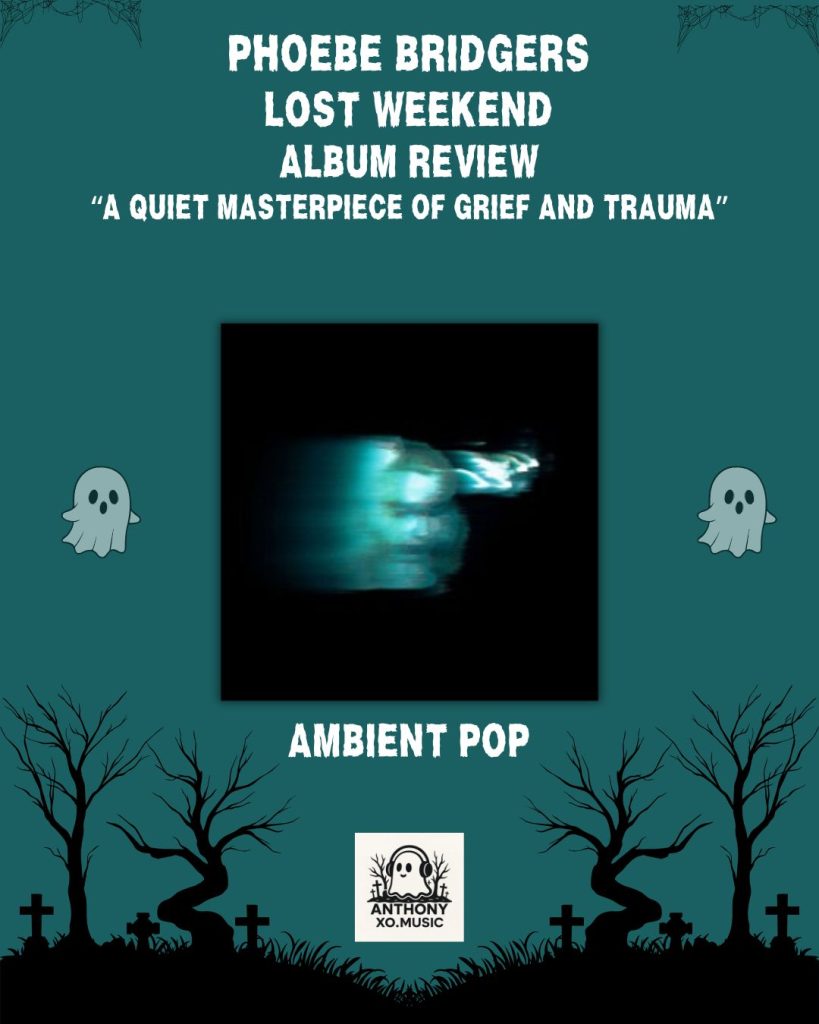
Phoebe Bridgers – Lost Weekend Album Review: A Quiet Masterpiece of Grief and Trauma
For buying merch and Live Tickets, visit Phoebe Bridgers’s Official Website
After releasing Punisher in 2020, Phoebe Bridgers quietly withdrew from the public eye. In the ensuing years, she faced a succession of personal hardships—the loss of her father, high-profile breakups, and the overwhelming weight of fame. Now, after a six-year hiatus, she has returned with Lost Weekend, a somber exploration of grief and trauma. As I navigate my own current challenges, listening to this album has become a profoundly cathartic experience. It is more than a mere collection of songs; it is a 52-minute distillation of a period marked by what critics describe as a “profound dislocation,” anchored by the sudden 2022 passing of her father and a total dissociation from the machinery of stardom.
The album is co-produced by a powerhouse team of Jack Antonoff and Alex G, and it offers a diverse and sophisticated soundscape. This has been one of my most highly anticipated releases.
My thoughts on this album are straightforward yet cathartic; I’d describe it as a quiet, filler-free masterpiece of summer 2026. As a fan of ambient music, this record felt like a holy grail, arriving at just the right time. It’s a celestial experience for anyone navigating pressure, trauma, or heartbreak—listening to it at midnight is truly evocative. With its serene atmosphere, the album feels like a healer, while Phoebe’s vocals are as refreshing as ice in a drink. Although the first half is standout and the second half is much more subdued, the project as a whole is a masterpiece that I know will stay with me for a long time.
Production-wise, the album is a masterclass—an unsurprising feat given its elite production team. Tony Berg, Ethan Gruska, Jack Antonoff, and Alex G prevent the record from feeling bloated, maintaining an impressionistic quality through intricate layering and sonic callbacks. The result is reminiscent of atmospheric ambient soundscapes, yet it boldly experiments with pop maximalism and orchestral Americana. Rather than sticking to one lane, the album explores multiple sonic directions with incisive precision. Even without vocals, the production’s sheer depth would cement it as a masterpiece for any fan of ambient music.
The songwriting on this album is deeply personal and impressionistic, delving into themes of loss, regret, heartbreak, and pressure. Phoebe eschews mainstream conventions, favoring artistic integrity over commercial hooks. By rejecting traditional pop structures in favor of more experimental forms, she effectively captures her emotional landscape. In the wake of these difficult experiences, her writing has become razor-sharp, delivering a cathartic and honest tribute to her father. This diverse masterpiece is a testament to her emotional transparency and meticulous craftsmanship.
Phoebe’s performance on this record is quiet, delicate, and incisive. To revisit the soda analogy: the production is the drink, and Phoebe’s performance is the ice that makes it truly refreshing.
The tracklist is remarkably cohesive, devoid of any obvious filler. While a few tracks in the second half lean into a slower, more deliberate pace, they never disrupt the album’s overall atmosphere. “The Outside” serves as a stunning opener, immediately establishing a sparse tone of isolation and observation through haunting ambient textures. It flows seamlessly into “Lost Boys,” a standout track that captures the frustration of relationships and the momentum of youth with its mid-tempo indie-rock pulse. “Kill Me” follows as a masterclass in glitch-pop maximalism, where vocoders and dark synths collide with Cameron Winter’s backing vocals to create an intense, razor-sharp experience. “Bobby” is a personal highlight, providing emotional grounding and a thematic anchor of stability amid the chaos of recent years.
It transitions into “Still Standing,” a deeply cathartic resilience anthem where Phoebe processes her father’s passing over uplifting piano and strings. While “Liberty Tree” introduces a nostalgic country flair with its banjo and folk-rock influences, it feels somewhat incongruous with the rest of the record—the only slight dip in an otherwise flawless run. The emotional weight intensifies with “Never Going Back!,” which features a heart-wrenching recorded voicemail from her father. “I Can’t Wait” then revitalizes the momentum, using high-stakes sound design and glitch-pop edges to prevent any late-album monotony. Finally, “As Above” offers an ethereal closing statement; its wash of ambient indie-folk and intricate layering creates a “snow globe” effect that perfectly prepares the listener for the final reprise.
Ultimately, Lost Weekend is a 52-minute extraction of the dislocation we’ve all been carrying since 2020, delivered as a “memory machine” that finally makes the chaos of the last six years feel purposeful. While the second half occasionally tests the listener’s patience by dipping into a stillness that feels almost too quiet, the record never collapses into the “filler-heavy slog” that plagues so many long-awaited returns. Instead, it functions as a hermetic “snow globe” of glitch-pop maximalism and orchestral Americana, where even the most agonizing moments—like the literal ghost of her father’s voice—are handled with razor-sharp emotional precision. Phoebe Bridgers has successfully avoided “coasting on her name” by taking a bold creative gamble that feels both haunting and unexpectedly stable. Anchored by the grounding presence of “Bobby” and the raw processing of Tony Bridgers’ passing, the album moves beyond simple indie-folk into a masterclass of atmosphere-as-storytelling. For anyone navigating their own “heavy post-pandemic disappointment,” this is a painstakingly potent holy grail of a record. It is a near-perfect reinvention that rewards the deep-dive, midnight listening it demands.
[Rating: 9/10]
- Favorite Tracks: The Outside, Lost Boys, Kill Me, Still Standing, Panorama, Lost Weekend, Never Going Back!, I Can’t Wait, As Above
- Least Favorite Tracks: Liberty Tree
Read My Reviews: