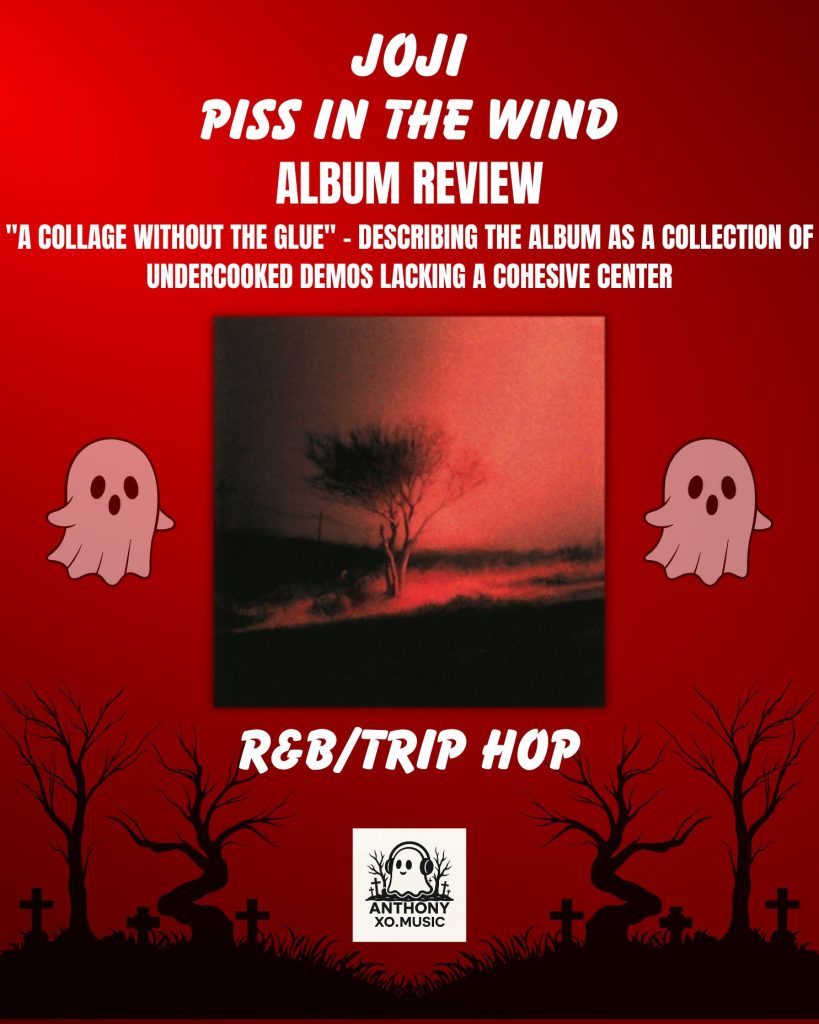
Hi everyone, it’s Anthony Stirford from Anthony XO.Music, and today I’m taking a deep dive into Joji’s latest album, Piss In The Wind.
Joji’s trajectory has been unusual by any industry standard. He began as an online content creator in the mid-2000s, built a massive audience through internet comedy, and then pivoted fully into music in the mid-2010s. What initially looked like a side project evolved into a legitimate R&B and alternative pop career. His 2018 debut, Ballads 1, introduced a stripped, emotionally raw sound that resonated widely. Tracks like “SLOW DANCING IN THE DARK” and “YEAH RIGHT” combined lo-fi textures, minimal percussion, and aching vocal delivery into songs that felt intimate but accessible.
Nectar in 2020 expanded that blueprint. It was more ambitious in scale, cleaner in production, and more diverse in sonic palette. It showed growth, even if it occasionally ran long. Then came Smithereens in 2022, a tighter and more focused record. While brief, it leaned heavily into vulnerability and featured “Glimpse Of Us,” arguably the defining moment of Joji’s career. That song distilled his strengths into one devastating ballad.
After a four-year gap, expectations for Piss In The Wind were understandably high. Instead, Joji returns with a 21-track album that runs under an hour. On paper, that suggests efficiency. In practice, it signals fragmentation. Several songs barely stretch past the one-minute mark, giving the project a sketchbook quality rather than the feel of a fully realized studio album.
Joji’s core aesthetic remains emotional minimalism. His music thrives on restraint: muted drums, hazy synth pads, sparse guitar lines, and a vocal performance that often feels whispered rather than sung. That formula still defines this album. The issue is not identity. The issue is execution. Across 21 tracks, the lack of dynamic variation becomes glaring.
The first half of the album settles into a subdued groove and rarely escapes it. The production is clean and professionally handled, but it leans heavily on the same atmospheric cues. Joji’s vocals, once compelling in their fragility, now feel overly passive. The melodies often drift rather than land. Hooks are understated to the point of being forgettable. What once felt intimate now risks feeling inert.
There are exceptions. The opener, “PIXELATED KISSES,” is one of the few moments where Joji sounds engaged. The instrumental palette feels slightly more adventurous, and his vocal presence carries a hint of confidence that cuts through the haze. “Cigarette” follows with a stronger rhythmic backbone, tapping into his signature melancholy while flirting with subtle hip hop cadences. These early highlights suggest the album could expand outward. It rarely does.
GIVEON’s appearance on “Piece Of You” is a smart pairing. His rich baritone contrasts effectively with Joji’s softer tone, giving the track a dimension that much of the album lacks. The collaboration feels organic rather than forced, and it briefly elevates the emotional stakes.
“Hotel California” stands as the album’s clearest standout. It captures the moody atmosphere that defines Joji’s appeal but pairs it with a genuinely memorable hook. The chorus lingers. The instrumental swells at the right moments. For once, the emotional arc feels complete. It is one of the few tracks that delivers a satisfying payoff rather than fading into abstraction.
“Sojourn” is another bright spot. It introduces a more experimental edge and feels like a conceptual cousin to the opening track. The transition into “CAN’T SEE SHIT IN THE CLUB” jolts the listener awake with a more upbeat, rhythm-driven approach. These moments hint at a willingness to stretch beyond the established formula. Unfortunately, they are scattered rather than central.
“Fragments,” featuring Don Toliver, further reinforces that point. The production incorporates harder drums and layered synth textures, creating a warmer and more immersive soundscape. Toliver’s melodic instincts complement Joji’s subdued delivery, and their vocal interplay provides one of the album’s more engaging moments. It feels contemporary without chasing trends.
However, these highlights are islands in an otherwise uniform landscape. The final stretch of the album struggles to justify its length. The closing tracks lack structural development and emotional escalation. They drift toward conclusion rather than building to one. For an artist known for introspective intensity, the absence of a climactic moment is striking.
The central problem with Piss In The Wind is not incompetence. The production is polished. The aesthetic is consistent. The performances are technically sound. The problem is creative stagnation. Cohesion is present, but contrast is scarce. Without peaks and valleys, the listening experience flattens. Emotional nuance requires variation. Here, the tonal range is narrow.
Joji sounds comfortable, perhaps excessively so. His restrained delivery once felt like a bold alternative to over-sung pop balladry. Across a 21-track project, that restraint begins to resemble limitation. There is little sense of risk, little sense of reinvention. The album reinforces his established mood rather than challenging it.
That does not make Piss In The Wind a failure. It has moments of genuine beauty and careful craft. But as a full-length statement following a four-year hiatus, it feels underwhelming. It plays more like a curated collection of sketches than a cohesive narrative arc with defined progression.
If this album was meant to mark a new chapter, it does not go far enough. If it was meant to consolidate Joji’s established identity, it achieves that goal. The question is whether consolidation is enough at this stage of his career.
In the end, Piss In The Wind is not a collapse. It is a plateau. And for an artist who once translated minimalism into emotional devastation, a plateau feels like a missed opportunity.
[Rating: 4/10]
- Favorite Tracks: Hotel California, PIXELATED KISSES, Past Won’t Leave My Bed, and “Fragments.
- Least Favorite Tracks: If It Only Gets Better, Love Me Better, Tarmac, Forehead Touch On The Ground, CAN’T SEE SH*T IN THE CLUB, and DYKILY.