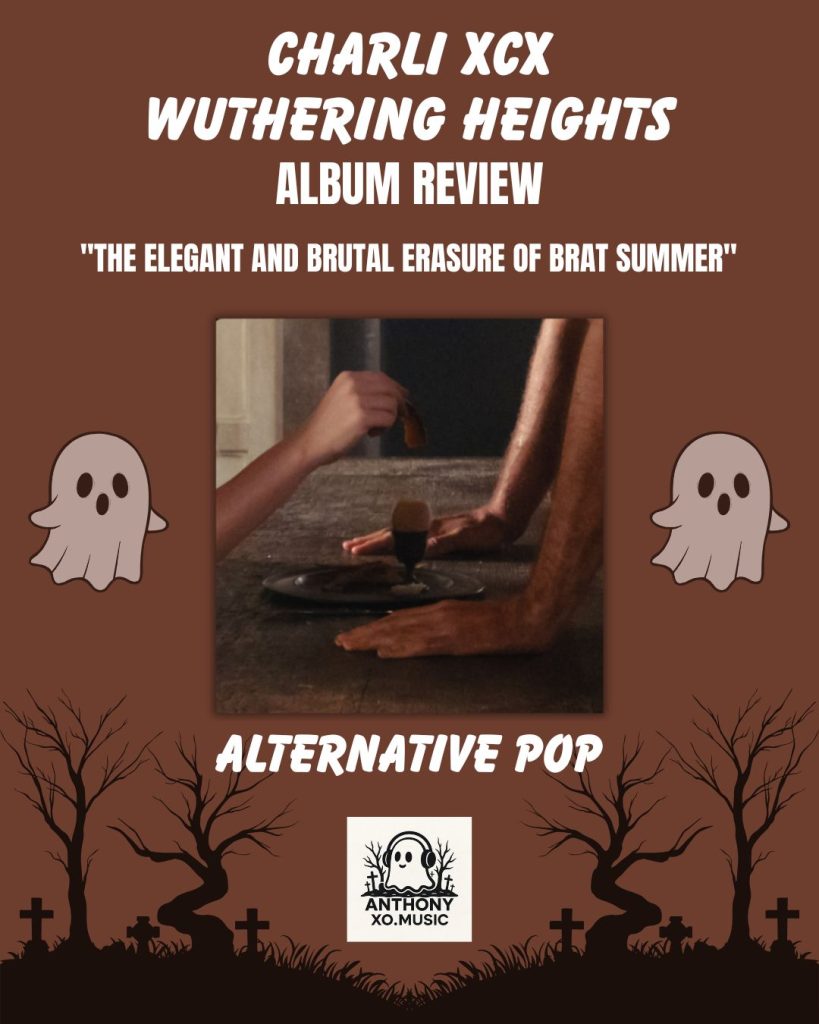
Charli xcx Wuthering Heights Album Review
Hi everyone. It’s Anthony Stirford here from Anthony XO.Music and today I’m here to review this new Charli xcx album, Wuthering Heights.
Now it’s been a decade long since Charli is evolving underground rave into mainstream pop visionary. Her 2013 album True Romance immediately showcased her talent to make glossy synth pop music with 80s inspired synths. Charli’s music gained mainstream attention when she appeared on the song “I Love It” with Icona Pop in 2012. That success expanded when she collaborated with Iggy Azalea on the song “Fancy”, it was a chart topping success. Her solo found a new direction when she dropped her 2014 single “Boom Clap”. This track showed significant growth on Charli’s career.
Since then she has been showcasing her ability to experiment modern pop music with electronic textures. In addition to that, her albums like Sucker, Charli, and How I’m Feeling Now significantly elaborated her sonical identity. Those albums met with very positive reaction from critics but couldn’t go to mainstream success.
Her 2024 album Brat was completely different. This album defined her career on a different level. It was raw, honest, and cohesive. The dynamic electronic sound of this album put Charli in several conversations. Brat wasn’t just a hit album for Charli, rather it was a career shifting project for her. It was a completely new direction for electro pop.
In addition to Brat, Charli is back in 2026 with a new project, Wuthering Heights and it’s not a sonical sequel to Brat rather a direct soundtrack for the Emerald Fennell movie, Wuthering Heights.
Sonically, this project mixes electronic textures with minimalistic dark wave, art pop, alt pop, and gothic music. The drums are clipped and dry, often snapping rather than blooming. Synths arrive in sharp, metallic bursts instead of the glossy washes that dominated her previous eras. There’s a deliberate minimalism at play. Space is used as tension rather than atmosphere. The arrangements feel stripped back but intentional, allowing silence and reverb tails to shape the mood rather than overwhelming synth layers.
But the restraint is inconsistent. Several tracks build around skeletal drum programming and brittle top lines, only to plateau before reaching catharsis. The production feels expensive and technically precise, yet occasionally risk-averse. Where earlier projects thrived on sensory overload, this album prefers icy distance. The mix foregrounds vocals with clinical clarity, sometimes at the expense of low-end impact. The bass rarely engulfs you. It pulses, but it doesn’t overwhelm. At times, this works in favor of the gothic tone. At other moments, it makes certain tracks feel emotionally muted.
The track “House” showed a very sultry moment in this album. Undeniably, it is the album’s darkest moment. John Cale’s spoken word speech created a minimal dark tone into the track and then Charli came up with fast paced vocals with an electronic tone. The contrast between Cale’s cold narration and Charli’s controlled urgency gives the song a cinematic intensity. The production stays sparse, allowing tension to build naturally. It’s one of the few moments where the album truly feels dangerous.
Another standout comes in the mid section of the album where the instrumentals lean heavier into distorted synth layers and industrial percussion. On that track, Charli’s vocals feel more emotionally exposed. There is less polish and more atmosphere. The hook lingers because it feels unstable, like it could collapse at any moment. This is where the album’s gothic aesthetic feels fully realized.
However, not every track reaches that level. Some of the slower cuts rely too heavily on repetition without adding new melodic or lyrical dimensions. A few songs feel more like transitional pieces for the film rather than fully developed standalone tracks. The minimal drum loops in these moments feel underdeveloped instead of intentionally restrained. While cohesion is strong across the album, memorability becomes an issue in its weaker stretches.
Lyrically, Charli leans into themes of obsession, longing, isolation, and emotional volatility. The writing complements the gothic atmosphere, but it often stays impressionistic rather than deeply narrative. Compared to the confessional sharpness of Brat, this project feels more atmospheric than personal. That choice makes sense within the context of a soundtrack, but it slightly reduces the emotional immediacy that defined her previous era.
In terms of career evolution, Wuthering Heights shows Charli refining her artistry rather than reinventing it. This is not an explosive reinvention. It is a controlled expansion into cinematic territory. She proves she can operate within a darker, more minimal framework without losing her identity. At the same time, the album does not feel as culturally disruptive as Brat. It feels calculated, composed, and aesthetically focused.
Overall, Wuthering Heights is a cohesive and well produced project that successfully captures a gothic cinematic mood. It delivers strong standout moments, especially with “House”, but it occasionally sacrifices impact for atmosphere. It proves Charli’s versatility and artistic intelligence, even if it doesn’t completely reach the emotional heights of her previous record.
[Rating: 7/10]
- Favorite Tracks: Wall Of Sound, Dying For You, and Out Of Myself.
- Least Favorite Track: Open Up
Question for the FitDay thread: In your post, could you share which DJ sets or live performances you’ve found to achieve that deeply cinematic, storytelling approach you’re seeking, and how you typically curate those moments in a live mix? For context, I’m curious if any European DJs are known for this narrative style, and if you’ve noticed common production techniques (tempo pacing, atmospheric layering, or spoken-word samples) that help create that cinematic feel in a club setting: https://www.fitday.com/fitness/forums/newcomers/39939-searching-djs-deep-cinematic-approach-music.html
That’s a thoughtful question. When I talk about a cinematic, storytelling approach in DJ culture, I’m thinking about sets that feel structured like a film rather than a playlist.
A few European DJs who consistently do this well:
• Tale Of Us – Their Afterlife sets are built on long-form tension. They stretch breakdowns, use emotional minor-key progressions, and let tracks breathe before introducing percussion. It feels like slow narrative escalation rather than constant drops.
• Âme (especially extended festival sets) – They’re masters of pacing. They often begin deep and restrained, gradually widening the harmonic space before landing in something euphoric. The journey is intentional.
• Ben Böhmer – His live performances lean heavily into melodic continuity. He layers pads and reverb tails so transitions feel like scene dissolves rather than cuts.
• Bicep (live) – Their use of atmospheric intros and emotionally loaded synth motifs creates arcs that feel episodic.
In terms of production techniques that create that cinematic feel:
Tempo discipline – Instead of dramatic BPM swings, gradual tempo shaping keeps immersion intact. The tension builds through density, not speed.
Atmospheric layering – Long pads, field recordings, filtered noise sweeps. These act like establishing shots in film.
Dynamic restraint – Delaying the “big moment.” Letting breakdowns sit longer than expected increases emotional payoff.
Spoken-word or textural vocals – When used sparingly, they add narrative implication without overpowering the groove.
When I curate moments like that in a live mix, I think in three acts:
– Opening: establish emotional tone, low percussive pressure
– Middle: introduce rhythmic drive and harmonic lift
– Final third: controlled catharsis, then a release or emotional comedown
For me, cinematic DJing isn’t about dramatic drops. It’s about tension management and emotional sequencing. The club becomes a narrative space rather than just a dancefloor.