Image Credits
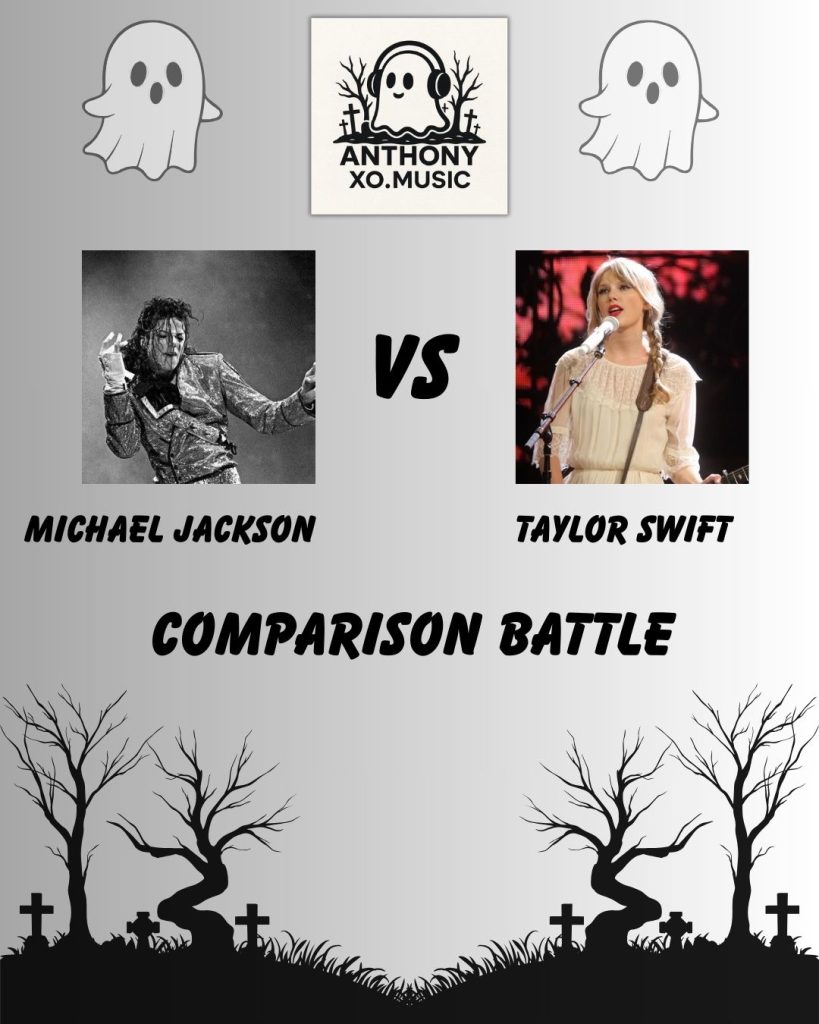
- Michael Jackson: Photo by Iranzinrlk via Wikimedia Commons. Licensed under CC0 1.0 Universal Public Domain Dedication.
- Taylor Swift: Photo by Eva Rinaldi via Wikimedia Commons. Licensed under Creative Commons Attribution-Share Alike 2.0 Generic.
Michael Jackson vs Taylor Swift Comparison – 5 Categories That Define Pop Greatness
The Michael Jackson vs Taylor Swift comparison isn’t close when you break it down into raw numbers. One built the global blueprint for pop. The other mastered the modern system. But only one actually dominates the stats.
Most critics are terrified of comparing a legacy that feels almost sacred to a career that’s still unfolding in real time. But if you care about music history, you can’t avoid the discussion forever. At Anthony XO.Music I don’t treat icons like museum pieces. I analyze them.
This is the King vs. the Queen.
Two completely different eras of pop dominance. Two completely different business environments. One artist built the blueprint for the global superstar. The other mastered the modern music economy.
Forty years of pop history. Five categories. Only one winner.
| Category | Michael Jackson | Taylor Swift |
|---|---|---|
| Album Sales | 500M+ | 120–150M |
| Peak Era | 1980s–90s | 2010s–2020s |
| Global Reach | Pre-internet global dominance | Streaming era dominance |
| Cultural Impact | Built pop blueprint | Redefined modern industry |
Category 01: Musical Identity & Originality
Michael Jackson
Jackson arguably holds the sharpest musical identity the industry has ever produced. Known worldwide as the King of Pop, he wasn’t just a hitmaker. He was a sonic architect.
His catalog fused pop, R&B, funk, rock, and disco into something universally digestible. It didn’t matter what continent you were on. The music translated instantly.
Albums like Thriller, Bad, and HIStory weren’t just popular records. They became templates. Artists have spent decades chasing the balance Jackson struck between spectacle, melody, and rhythm.
And then there’s the performance factor. The voice, the phrasing, the choreography, the stage presence. Jackson wasn’t simply recording songs. He was creating a new visual language for pop music itself.
Taylor Swift
Swift’s musical identity operates very differently. She’s not built on spectacle. She’s built on narrative.
Her career started in country music before pivoting into pop in the mid-2010s. What separates her from most artists is the autobiographical engine behind the catalog. Every era functions like a diary chapter.
Fans don’t just listen to Swift. They track her life through the music.
From teenage heartbreak to adult reflection, her songwriting became a generational mirror. That intimacy is the foundation of her empire.
While Jackson defined performance-driven pop, Swift perfected story-driven pop. Both approaches are powerful. But historically speaking, Jackson’s blueprint reshaped the entire industry.
Winner: Michael Jackson
(He defined the pop formula that still echoes today, while Swift defines the modern streaming-era identity.)
Category 02: Albums & Artistic Consistency
Michael Jackson
Jackson’s early solo career had some shaky ground. But once Off the Wall arrived, the trajectory changed overnight. From that point forward, he operated at a different altitude.
Thriller remains the best-selling album in music history. Not just in one decade. In the entire recorded era.
Then came Bad, which produced five No.1 singles on the Billboard Hot 100. A record that still stands.
Songs like “Beat It” and “Billie Jean” didn’t just dominate radio. They became permanent pieces of pop culture.
Jackson’s album run from Off the Wall through Dangerous is one of the strongest commercial streaks ever recorded. And the numbers matter. Legacy isn’t built on streaming spikes or opening-week hype. It’s built on lifetime impact.
Jackson has sold over 500 million records worldwide.
Taylor Swift
Swift’s catalog tells a different story. Her strength lies in sustained momentum across eras. After her debut album, Fearless exploded in 2008 and changed everything. From there she pivoted genres multiple times without losing her audience.
The move from country to pop with 1989 could have destroyed her career. Instead it made her bigger than ever.
Since then, every era has felt like a cultural event. She dominates streaming platforms, first-week sales, and tour revenue. No modern artist controls the commercial machinery of the industry the way Swift does.
But when the conversation shifts to lifetime album sales, the gap becomes undeniable.
Swift’s catalog sits roughly around 120–150 million units worldwide. That’s massive for the streaming era. But it’s still far from Jackson’s half-billion benchmark.
Winner: Michael Jackson
(Pure lifetime album dominance still belongs to MJ.)
Category 03: Lyrics & Emotional Impact
Michael Jackson
Jackson’s lyrical reputation is often overshadowed by his performance mythology. People remember the moonwalk first. The songwriting comes second.
But when you actually read the lyrics, the themes were often socially aware. “They Don’t Care About Us” carried political anger. “Earth Song” tackled environmental destruction and human responsibility.
Jackson wasn’t afraid to address global issues. That said, the emotional engine of his music was usually performance-driven. The voice. The rhythm. The spectacle.
Fans felt the emotion through the experience of the music rather than dissecting the lyrics themselves.
Taylor Swift
Swift flips that formula completely. Her entire career is built on songwriting transparency.
Every album reads like a diary entry. Fans analyze lines the way literature students analyze poetry.
You can track her life across eras: the teenage vulnerability of early records, the emotional chaos around Red, the pop confidence of 1989, the defensive fury of Reputation, and the reflective tone of recent work.
The connection between artist and listener becomes deeply personal. Listeners don’t just hear Swift’s songs. They see themselves in them. That level of lyrical intimacy is extremely rare in mainstream pop.
Winner: Taylor Swift
(Her songwriting forms a direct emotional bridge to the audience.)
Category 04: Commercial Success & Global Reach
Michael Jackson
At his peak, Jackson was arguably the most recognizable entertainer on the planet.
His influence reached far beyond Western markets. Asia, Africa, South America, Europe. Every continent embraced him.
The visuals played a massive role. Jackson’s dance style turned music videos into global cultural events.
There’s a famous example people often overlook. You could walk into remote Asian villages decades ago and find posters of Michael Jackson hanging on walls where many people had never even heard of The Beatles or Elvis Presley.
That’s the level of reach we’re talking about. Jackson also achieved a statistical milestone very few artists can touch: Top 10 singles across five different decades.
That’s not just popularity. That’s cultural endurance.
Taylor Swift
Swift dominates the modern era. Her tours generate billions in revenue. Her albums dominate streaming charts. Her fan engagement is unmatched in the digital age.
She is almost certainly the largest active artist of the 21st century. However, her influence exists largely within the infrastructure of the internet age. Social media, streaming platforms, digital fandom ecosystems.
Jackson’s reach developed in a pre-internet world and still crossed every border imaginable.
Winner: Michael Jackson
(Global recognition on a scale that predates and outlasts the internet.)
Category 05: Cultural Impact
Michael Jackson
Jackson didn’t just influence pop music. He redefined what a pop star looked like. The choreography. The cinematic music videos. The stadium spectacle.
Artists like The Weeknd, Bruno Mars, and Chris Brown openly credit Jackson as a foundational inspiration. Even after his death in 2009, the blueprint remains intact.
Modern pop performance still operates within the framework he built.
Taylor Swift
Swift’s cultural impact operates on a different axis. She didn’t redefine performance. She redefined the business of music.
Her fight for artist ownership, the massive re-recording campaign of her catalog, and her direct fan communication changed how artists think about power in the industry.
She also turned the pop star into something closer to an ongoing narrative experience. Every album era becomes a chapter that fans participate in.
In many ways, Swift reshaped the modern relationship between artist, audience, and commerce. But Jackson reshaped the human experience of pop performance itself.
Winner: Michael Jackson
(His influence remains the DNA of the modern pop superstar.)
Final Verdict
Taylor Swift is the ultimate 21st-century empire. She mastered the streaming economy, weaponized songwriting intimacy, and turned artist ownership into a global conversation. No active musician currently controls the industry’s modern mechanics the way she does.
But Michael Jackson was something different entirely. He wasn’t just dominant inside the industry. He changed how the entire world experienced music. The visuals. The performance language. The scale of global celebrity.
Swift conquered the system. Jackson helped build the system.
When you step back and look at the math, the sales, the reach, and the cultural blueprint, the conclusion becomes difficult to dispute. Swift rules the modern era, but Jackson built the throne.
Winner of the Comparison Battle: Michael Jackson (4–1)
If you enjoyed this breakdown, read my other comparison battles: