Vince Staples – Cry Baby Album Review: The Most Important Rap Album of 2026 Falls Just Short of Greatness
For buying merch and Live Tickets, visit Vince Staples’s official website: https://www.vincestaples.co/
Back in April, Vince Staples dropped a line on Instagram that instantly cut through the usual internet noise: “As the world burns, I have decided to release this album.” Since then, Cry Baby has easily become one of the most anticipated drops of 2026. Look, I’ll be completely honest here—even though Vince is a massive name in political hip-hop, I didn’t know who he was until this week. I literally stumbled onto his release dates while digging through Wikipedia. But when an album promises to tear down the system, I’m locking in immediately. Honestly, I am so done with the mainstream music landscape right now. Radio trends are completely swallowed up by artificial pop vibes, flexing wealth, and hollow breakup songs. My listening habits have leaned way harder into raw, personal stories about real struggles and the inevitable backstabbing you face when chasing a dream.
So finding out that Cry Baby was this conceptually heavy, guitar-driven dive into a corrupt system and the modern Black struggle completely hooked me. I might be totally new to Vince’s world, but I know what a political masterclass sounds like; I’ve spent years spinning Kendrick Lamar’s To Pimp a Butterfly and DAMN.
While a title like Cry Baby might make you think of Lil Peep’s emo-rap style, Vince is executing a completely different narrative. Here, the phrase is a venomous political double entendre. It simultaneously mocks the absolute exhaustion that makes people want to surrender to an oppressive system, while weaponizing the insult of childish weakness right back at America’s violent hypocrisy. The second track, “White Flag,” masterfully spins the concept of surrender into a symbol of pure generational fatigue. Over a bed of live, post-punk instrumentation, Vince raps that “sometimes love can turn to war,” hitting on the grim reality that crying out for help feels completely pointless when the system is literally built to ignore your distress. This narrative of a white flag and a crying baby feels heavily tied to the current political climate, echoing the chaotic energy surrounding Donald Trump’s presidential campaign and the deep divisions across the country right now.
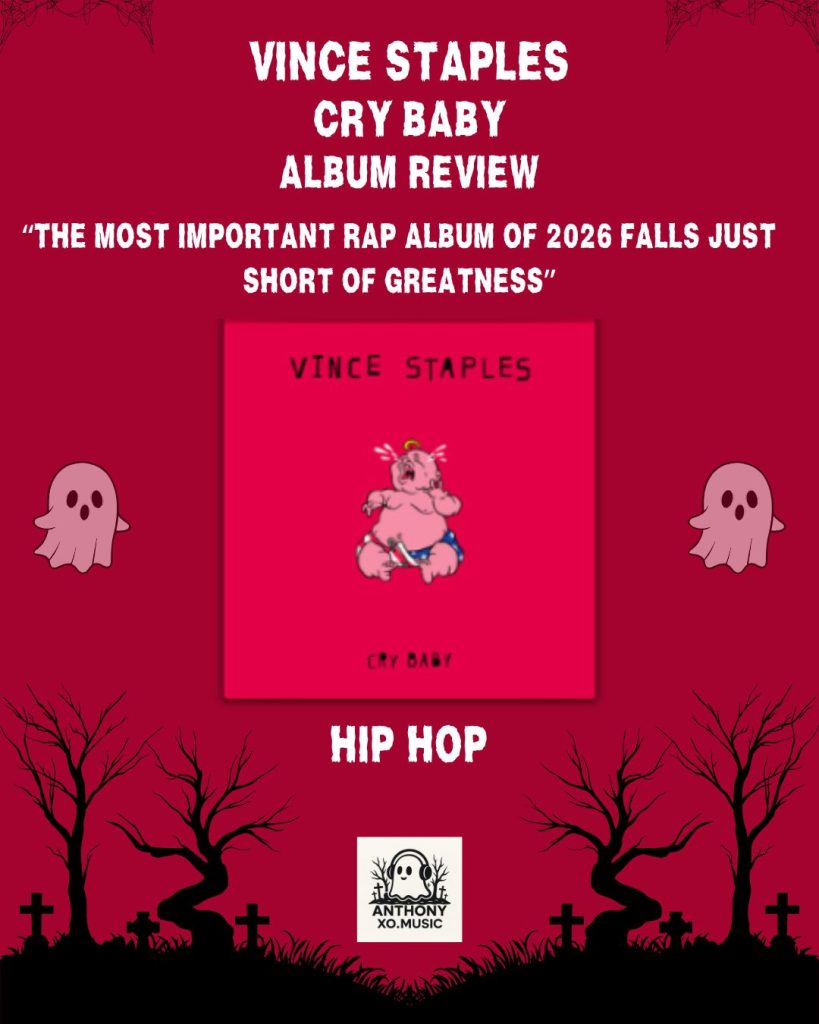
That underlying cynicism punches you right in the face when you look at the album artwork. Set against a harsh, violent red background, the cover shows a cartoon baby wearing a diaper patterned after the American flag. This imagery immediately brings to mind Donald Trump and his MAGA campaign. It forces together themes of white entitlement, aggressive nationalism, and unchecked, infantile power into a single, cohesive image of a superpower that stubbornly refuses to grow up. The blood-red backdrop screams urgency and systemic violence. At the same time, that flag-diaper baby highlights the ultimate failure of the American dream: a nation that treats its own vulnerable citizens like disposable infants—wrapping them tightly in patriotic symbolism while abandoning them entirely to the surrounding chaos.
When it comes to the pen game, Vince’s voice is completely baked into the political chaos of the record. As I mentioned earlier, I’ve been spinning Kendrick Lamar’s conscious masterworks since I was a kid. But where Kendrick leans into dense, theatrical storytelling, Vince hits you like a straight-up sledgehammer. He doesn’t hide behind metaphors—he names names, attacks hypocrites, and looks the system dead in the eye. For a critic who is totally exhausted by safe radio pop, hearing someone use their lyrics as a weapon like this is the absolute holy grail.
Look at how they handle police brutality. Kendrick famously gave us the complex, poetic layers of To Pimp A Butterfly, rapping, “we hate po-po, wanna kill us in the street for sure.” Vince, on the other hand, boils that entire systemic nightmare down into a single, chillingly direct question on the album: “Is this harassment or arrest?” It proves exactly why his writing works; he trades Kendrick’s complexity for raw, unfiltered clarity. The entire record operates as an unvarnished diary of the modern Black struggle against corrupt institutions. On the opening track, “Blackberry Marmalade,” his blunt, repetitive use of the N-word serves as a harsh reminder of what life actually looks like for Black youth in a country that constantly brags about equality and free speech. Even the music video drives this home, closing with that iconic Martin Luther King Jr. quote about choosing what kind of extremist you will be.
Vince’s verses are incredibly strong, and honestly, I loved almost every bar on the tracklist. But there’s one structural choice that completely stalled my momentum, and it’s the same issue that made me slam Labrinth’s recent music. After dropping these brilliant, fiery verses, Vince constantly retreats into these chantable, heavily repeated choruses. Now, to be fair, in political hip-hop, a repetitive chant is practically a mandatory protest slogan—it’s designed to be an anthem, not a catchy pop hook. So I can’t call them objectively “bad” songwriting, especially since this isn’t an album meant for casual playlist vibes. But for my personal taste, hearing that same repetitive structure copied and pasted across multiple tracks crosses the line from impactful to just plain annoying. It doesn’t entirely ruin the heavy atmosphere of the album, but the constant repetition definitely dulls the sharp edge of his songwriting right when he needs it most.
When it comes to the actual sonic architecture of the record, this is where Vince completely separates himself from the rest of the hip-hop landscape. He’s often praised as a master of genre crossovers, and Cry Baby makes it entirely obvious why. Even though this is fundamentally a heavy political rap album, the production aggressively charges straight into punk, noise rock, and rap-rock territory. Taking a live-band approach like that is an incredibly risky gamble in modern hip-hop, but it works completely in Vince’s favor. The abrasive, distorted rock instrumentation acts as the perfect, chaotic backdrop for him to brutally attack the system. During my research, I found out that this is a massive shift from his earlier signature sound, which usually relied on minimalist, electronic, sample-driven loops. Here, the production switches to full live instrumentation, and the energy is night and day. The sonic palette is absolutely wild, effortlessly shifting between gritty funk stompers, aggressive post-punk riffs, classic West Coast basslines, and even moments of warped, psychedelic jazz. It’s a beautifully unpredictable, stressful musical environment that forces you to pay attention, giving Vince the exact explosive platform he needs to deliver his verses with absolute authority.
Ultimately, Cry Baby is a heavy, uncompromising record that doesn’t care about making the listener comfortable. Vince Staples delivers a masterclass in direct lyricism, stripping away any poetic filter to expose how the idealized American Dream is completely hollow inside if you are forced to start from zero. The sonic arrangement is incredibly strong and intact; despite shifting across various live rock and funk genres, the production never loses its tight grip on the album’s urgent atmosphere. I deeply appreciate how fearless this project is as a direct shot to a bad system—it’s exactly the kind of substance I crave when mainstream pop music feels entirely empty. However, despite its structural brilliance and political fury, Cry Baby simply doesn’t have that monumental, world-stopping replay appeal that made Kendrick Lamar’s To Pimp a Butterfly and DAMN. such legendary cultural benchmarks. It’s an essential, abrasive statement for 2026, but one that demands a specific mood to fully endure.
[Rating: 7/10]
- Favorite Tracks: Blackberry Marmalade, Go! Go! Gorilla, White Flag, The Running Man, The Big Bad Wolf, Do You Know The Devil, Cotton, 7 In The Morning
- Least Favorite Tracks: TV Guide
Read More Reviews: