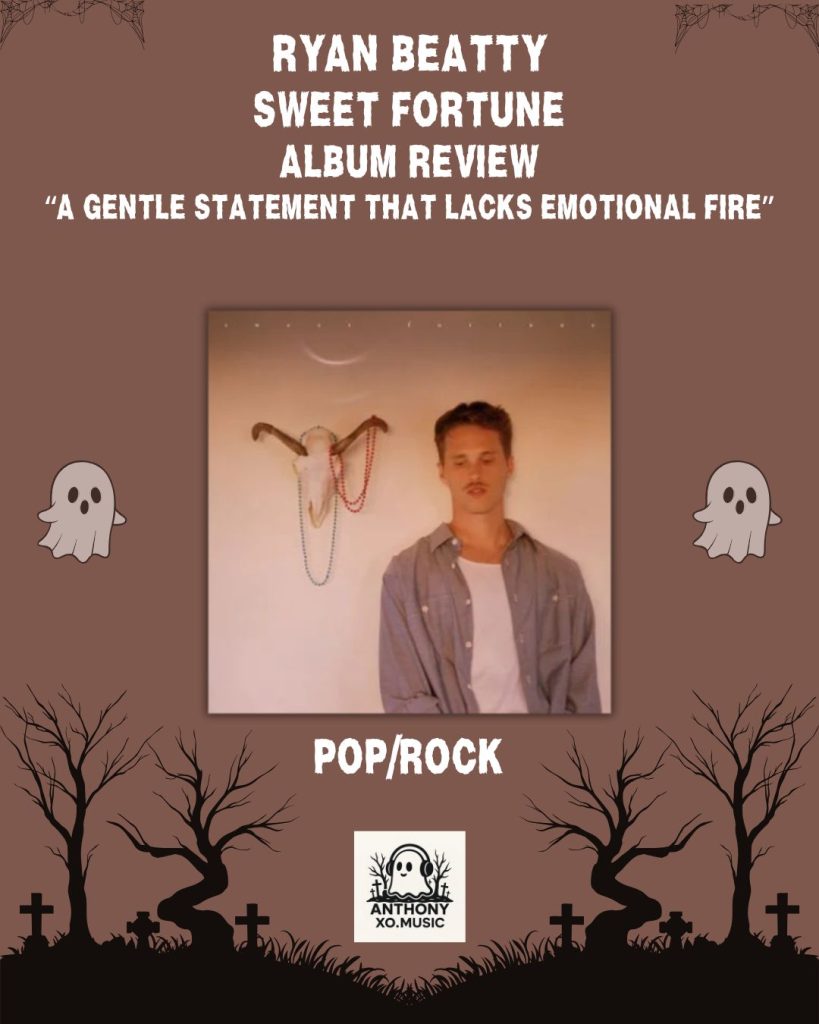
Ryan Beatty – Sweet Fortune Album Review: A Gentle Statement That Lacks Emotional Fire
For buying merch and Live Tickets, visit Ryan Beatty’s official website: https://www.ryanbeatty.com/
It is often said in music criticism that pain provides the most natural narrative arc for an artist, but on Sweet Fortune, Ryan Beatty makes the radical, bold move of choosing happiness instead. This creative shift arrives three years after his critically acclaimed 2023 album Calico, which was widely praised for its exceptional songwriting and immaculate vocal quality. Since then, Beatty’s industry stature has skyrocketed, recently solidifying his status as a Grammy-winning artist for his contributions to Beyoncé’s monumental Cowboy Carter album.
His path to this moment has been a fascinating evolution. Emerging from the early 2010s internet era as a viral discovery, he initially caught the public’s eye with a highly successful YouTube cover of Bruno Mars’s “Marry You”, which quickly accumulated millions of views and jump-started his early pop career. From there, Beatty forged a path entirely his own, stepping into a new sense of artistic agency when he publicly came out as a gay man in 2016.
He firmly established himself as a respected, singular voice in the late-2010s indie landscape with his debut album Boy in Jeans—a project whose iconic, high-fashion album cover remains incredibly striking to me today. Before delivering the hushed intimacy of Calico, he spent years sharpening his pen as a go-to collaborator for alternative powerhouses like Tyler, the Creator, and Brockhampton. Now, he returns with his fourth studio album, Sweet Fortune. Entering this project with expectations of it being his warmest, most joyful, and gentlest statement to date, Beatty beautifully redefines what a modern indie-pop record can feel like.
To me, Sweet Fortune is undeniably a great, gentle statement, and there are aspects of its quiet nature that I genuinely love. However, I have to push back on the pre-release narrative, framing this as his warmest or most joyful record to date. While it certainly operates in a peaceful space, I can easily name several better warm and quiet albums from this year that I have been loving far more thoroughly.
Projects like Kacey Musgraves’ Middle Of Nowhere, Friko’s Something Worth Waiting, Aldous Harding’s Train on the Island, and the latest release from My New Band Believe all capture that cozy, inviting atmosphere with much more resonance. In contrast, Sweet Fortune often feels too quiet, too mellow, and too gentle, lacking the true emotional heat required to make it feel deeply warm. This restraint ultimately makes the project feel like a somewhat lukewarm effort—a sentiment also shared by Anthony Fantano.
Given Beatty’s immense talent, the music should have been far more adventurous and sonically enjoyable, but it frequently chooses to stand completely still instead. That being said, I absolutely cannot ignore Ryan’s artistic genius here, and this album is by no means awful. It simply missed the mark of what I originally expected from him. His core storytelling skill remains completely undeniable; whereas the songwriting on Calico felt explicitly diaristic, that same intimate style is far more refined and polished on this record, even if the surrounding musical backdrop leaves you wanting a bit more color.
From a technical standpoint, the production on Sweet Fortune—co-produced alongside longtime collaborator Ethan Gruska—is a masterclass in minimalistic and intimate brilliance. The sonic architecture utilizes “illuminated piano,” “glacial keys,” and “blooming strings” to create a cozy, perfectly designed sanctuary that expands and contracts with genuine warmth. This soft, bedroom-pop-adjacent atmosphere beautifully hits every marker for the contemporary Gen Z “soft aesthetic,” providing a stunning backdrop of folky vignettes that fit seamlessly into the album’s core elements.
However, this restraint quickly reveals itself to be a double-edged sword. While Gruska’s arrangements provide a beautiful home, Ryan Beatty’s vocal performance is almost too settled within it; he occasionally feels like a guest who has fallen asleep in his own beautifully designed house. His vocal delivery is so unhurried, mellow, and characterized by such an exacting restraint that it strips away the tension and gravity that made Calico so gripping.
There is an incredibly fine line between a warm register and a performance so gentle it becomes completely static. By leaning so heavily into this ultra-cozy devotion, his signature preternatural linguistic precision ends up muffled, sacrificing the record’s emotional pulse to maintain a soft aesthetic.
While the majority of the tracklist across Sweet Fortune lands in a relatively mediocre territory—often missing the golden opportunity to evoke a truly deep emotional response—there are still a few specific moments that genuinely shine. The album kicks off on an incredibly powerful note with the opening track, “Phantom.” Instead of relying on empty grandeur, the song establishes itself as moody, opulent, and thoroughly warm, driven by a cathartic approach to songwriting that stands out as an immediate highlight.
This initial momentum is supported later by “Annie, Anything,” a track that, while not necessarily the absolute best offering on the project, succeeds by being beautifully intimate, organic, soft, and sweeping in its execution.
However, the middle of the tracklist introduces some notable friction, particularly with the song “Too Many Ways.” While it is a fundamentally good track, it caused a bit of musical confusion during my initial listens. The sonic progression sounds strikingly similar to Kacey Musgraves’ recent track “Middle Of Nowhere.”
Diving deeper back into that Musgraves record, elements of her tracks “Back On The Wagon” and “Uncertain, TX” also share a very similar DNA. While the stylistic nuances are explicitly present enough to avoid any direct accusations of copying, the striking similarities still pull you out of the album’s unique world.
Unfortunately, that immersion breaks down entirely on “White Lightning” and “Delancey.” Despite boasting technically solid writing on paper, both tracks are completely dragged down by Ryan’s vocal performance, which feels so uninspired, flat, and genuinely boring that the songs become entirely forgettable.
Ultimately, Sweet Fortune stands as a beautifully constructed but frustratingly static chapter in Ryan Beatty’s career. Choosing happiness over pain is undoubtedly a bold artistic pivot, and the diaristic storytelling on this record proves his brilliant songwriting skills are more refined than ever. Ethan Gruska’s minimalistic, bedroom-pop production handles the Gen Z “soft aesthetic” with incredible care, creating an intimate sonic sanctuary filled with gorgeous, glacial keys.
However, by surrendering completely to this ultra-mellow landscape, Beatty lets the album’s emotional pulse slip away. His vocal delivery is so unhurried and heavily restrained that it often lacks the vital tension and gravity needed to truly make these songs connect. While tracks like “Phantom” and “Annie, Anything” offer flashes of warm brilliance, much of the remaining tracklist suffers from a boring execution, leaving the project feeling lukewarm rather than adventurous.
Sweet Fortune is far from a bad album, and Beatty’s genius remains undeniable, but it ultimately settles too comfortably into its cozy aesthetics, leaving us with a gentle statement that is simply too quiet to leave a lasting impact.
[Rating: 6/10]
- Favorite Tracks: Phantom, Sweet Fortune, Too Many Ways, Annie, Anything, Dust
- Least Favorite Tracks: White Lightning, Delancey
Read More Reviews: