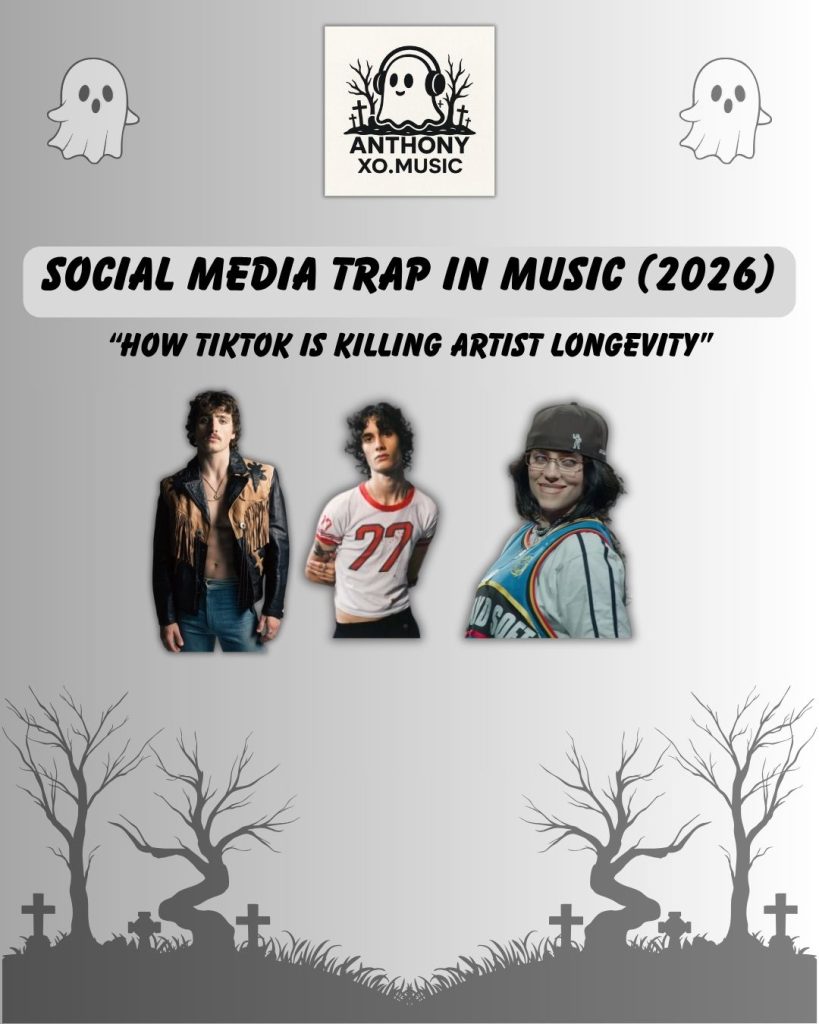
Social Media Trap in Music (2026): How TikTok Is Killing Artist Longevity
TikTok didn’t just change how music spreads. It changed what artists aim for.
A decade ago, the goal was to build a catalog. Now, the goal is to trigger a reaction. A hook. A loop. A moment that survives for 15 seconds and disappears by next week. In 2026, virality isn’t rare. It’s expected. And because of that, it means less than ever.
At Anthony XO.Music, I don’t measure success by streams or trends. I measure it by structure. Production Stability. Replay Value. Career Trajectory. And right now, most artists are failing that test.
The industry is no longer developing identities. It’s manufacturing content. Some artists are already feeling the consequences. Some are standing at the edge. And a few have actually figured out how to survive it.
Part One: The Viral Trap — The Affected
This is what happens when artists win the algorithm but lose the foundation. The Viral Trap doesn’t destroy careers overnight. It weakens them slowly. The production becomes safer. The identity becomes thinner. The momentum becomes harder to hold onto. These artists didn’t lack talent. They lacked direction after the hit.
Benson Boone
Boone was everywhere in 2024 because of “Beautiful Things.” The numbers were massive. The attention was real. But the foundation wasn’t. His first two albums flopped. Even the second one, with all that hype behind it, collapsed quickly. American Heart only moved because of leftover internet momentum. Look at the actual impact. No major awards. No Grammy nominations. No presence on year-end lists. And the second-week drop tells the real story. The moment was loud. The career wasn’t.
Shaboozey
“A Bar Song” gave him a massive platform. He couldn’t hold it. His 2025 run was messy, inconsistent, and completely directionless. Even with a Grammy win through a collaboration, the solo trajectory is fading fast. Virality gave him attention. It didn’t give him stability.
Dua Lipa
Dua Lipa built her identity early. The first two albums were sharp, controlled, and effective. Then the evolution stopped. Radical Optimism wasn’t just underwhelming. It felt stuck. The 80s-inspired sound that once defined her now feels repetitive. The audience is catching on. What once felt polished now just feels predictable. She didn’t collapse. She plateaued.
Camila Cabello
In 2019, she was everywhere. In 2026, she’s invisible. Familia failed. C,XOXO barely made an impact. And the artistic decisions, especially certain collaborations, only made things worse. The biggest issue isn’t failure. It’s identity loss. There’s no consistent sound. No direction. No real reason to stay invested.
Teddy Swims
This is where hype completely disconnects from reality. “Lose Control” spent 112 weeks on the Hot 100. On paper, that looks historic. In practice, it’s one of the most overrated songs in recent memory. The hook is generic. The structure is predictable. There’s nothing pulling you back after the first listen. Longevity on charts doesn’t always mean replay value. Sometimes it just means exposure.
Lil Nas X
He was supposed to define a generation. “Old Town Road.” “Montero.” Massive cultural moments. Then silence. No major follow-up era. No defining second phase. No sustained presence in the conversation. The internet made him explode. It didn’t help him evolve.
Jack Harlow
Harlow built his career on viral pop-rap. “First Class.” “Lovin On Me.” Big moments driven entirely by internet momentum. But the albums never matched the singles. Now he’s pivoting into R&B, and it’s not working. Monica debuting around number 40 on the Billboard 200 says everything. He didn’t build an identity. He followed a wave.
Roddy Ricch
“The Box” made him look unstoppable. That illusion didn’t last. Delays, inconsistency, and a lack of evolution have stalled everything. The Navy Album feels more like a question mark than a comeback. Early virality created expectations. He never built the structure to meet them.
Ice Spice
The hype was undeniable. Viral hits. Strong collaborations. Real cultural presence. Then the album dropped. And it didn’t hold. Critically, it fell apart. The quality didn’t match the momentum. That’s the actual risk of building entirely on moments. When the moment fades, there’s nothing underneath. The pattern is clear. The algorithm rewards speed. But speed without structure leads to collapse.
Part Two: The Danger Zone — The Crossroads
This is where careers are actually decided. These artists are winning right now. Strong numbers. Strong visibility. Real cultural momentum. But none of that guarantees longevity. This phase isn’t about success. It’s about direction.
Olivia Rodrigo
Olivia is already established. The voice is clear. The identity is strong. But there’s a safety net. Dan Nigro has played a huge role in shaping her sound. The real test comes when that formula gets challenged. Her next album isn’t just another release. It’s a turning point.
sombr
There’s real potential here. But a lot of it is still tied to hooks. Viral moments. Immediate appeal. “Back to Friends” worked. Now the question is simple. Can he build beyond that?
Tyla
She’s not a one-hit wonder. “Water” was global. “Chanel” proved consistency. But repetition is already a risk. If the sound doesn’t evolve, the ceiling will arrive faster than expected.
Olivia Dean
Right now, she’s one of the most respected names in the space. The momentum is strong. The recognition is real. But being the “Grammy darling” comes with pressure. The next project can’t be safe. It can’t be predictable. It has to actually define her.
Addison Rae
The transition from influencer to artist actually worked. The debut project gained attention. The singles connected. Even award recognition followed. But that only raises the stakes. Right now, she’s still proving she’s more than a moment.
Jessie Murph
A strong foundation is forming. The debut had mixed reception, but the potential is obvious. The versatility is there. Now it needs structure.
Alex Warren
This is the clearest warning sign. One hit success followed by a poorly received album. “Ordinary” worked. The album didn’t. And the follow-up singles aren’t helping. One song can open the door. It can’t build the house. The first hit creates attention. The next phase reveals identity. Most artists don’t survive that transition.
Part Three: The Survivors — The Architects
These artists understand the system. But they don’t depend on it. They don’t build for the scroll. They build something that holds without it.
Billie Eilish
The defining artist of Gen Z. Not because of numbers. Because of identity. She used the internet to amplify her sound, not replace it. Every project feels intentional. Every release has structure. She didn’t adapt to the system. She bent it around her.
BTS
A global blueprint. The internet didn’t dilute their identity. It expanded it. Their fanbase is one of the most loyal in music history, and their comeback projects continue to prove their scale. This is what happens when virality is controlled instead of chased.
Central Cee
Consistency is the difference. He didn’t abandon his sound to chase trends. He refined it. UK drill didn’t limit him. He defined it.
Underscores
This is what artistic focus actually looks like. No chasing hits. No algorithm dependency. Just building identity through sound. Wallsocket was a statement. U is confirmation. Critical acclaim follows structure.
Hemlocke Springs
Unpredictable. Unique. Intentional. Her music doesn’t sound like it’s trying to fit anywhere. That’s exactly why it stands out.
Sabrina Carpenter
She understood the moment. Then she built beyond it. The transition from visibility to identity is already happening.
Chappell Roan
A clear artistic vision. Strong aesthetic. Strong sonic direction. She’s not just present. She’s defined.
Blackpink (Solo Era)
As individuals, the identity is expanding. Different sounds. Different directions. Still evolving. But moving toward something real.
Architects don’t chase relevance. They build permanence.
Final Verdict
The industry didn’t lose talent. It lost focus. Artists are being trained to win moments instead of building meaning. To chase engagement instead of crafting identity. And the result is visible everywhere. Shorter peaks. Faster declines. Forgettable catalogs. The algorithm can make you famous. It cannot make you last.
Gen Z doesn’t need more viral stars. It needs Architects. Artists who build for the soul, not the scroll. Because in the end, the moment fades. The structure doesn’t.
If you enjoyed this breakdown read more articles here:
Image Credits:
- Billie Eilish: Official Press Still via Interscope / Impericon.
- sombr: Photography by Bryce Glenn / Warner Records.
- Benson Boone: Official Media Assets / Warner Records.