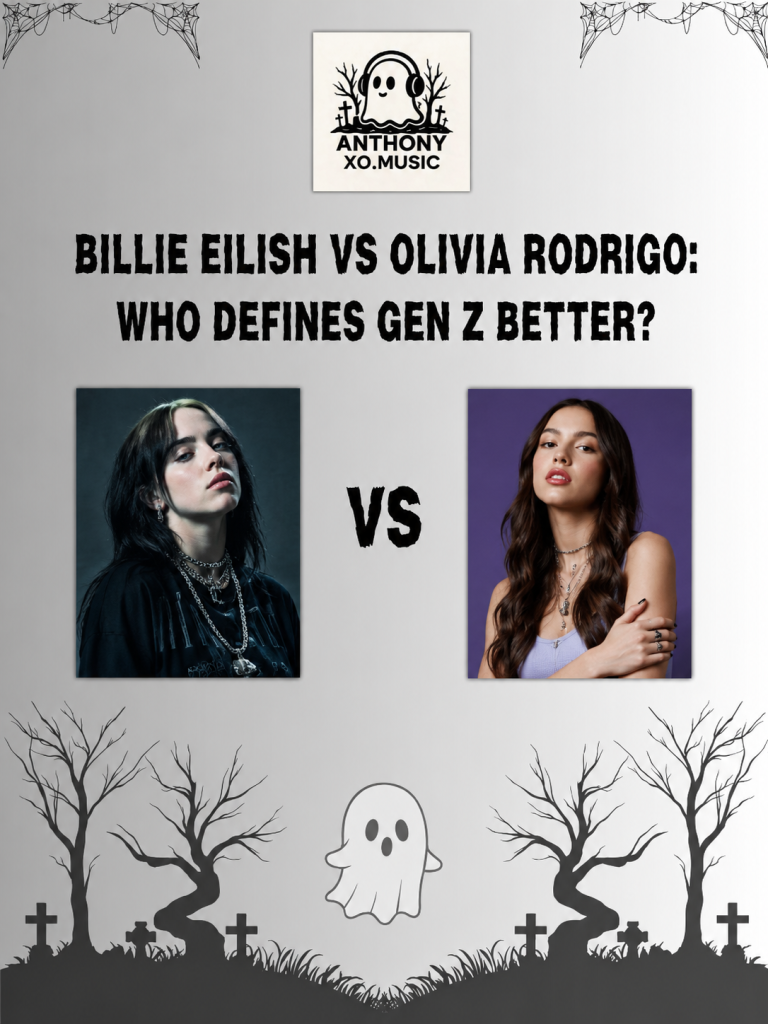
Billie Eilish vs Olivia Rodrigo: Who Defines Gen Z Better?
The pop landscape doesn’t do nuance anymore. You are either a cult-like, atmospheric goth whisperer or a high-drama theater kid reclaiming 2000s mall-rock. Billie Eilish and Olivia Rodrigo aren’t just two artists occupying the top tier of the music industry; they represent the undisputed “Big Two” of Gen-Z pop.
This isn’t a friendly debate—it’s an ideological civil war. One treats the bedroom pop aesthetic as a dark, cryptic religion, while the other weaponizes raw teenage diary entries, slaps heavy guitar distortion over them, and watches the charts shatter.
With Olivia’s brand-new third record, You Seem Pretty Sad for a Girl So in Love, dropping this month, she is stepping right back into a head-to-head collision with Billie’s unstoppable, record-breaking Hit Me Hard and Soft streaming era. As of today, Billie stands with three distinct studio albums under her belt, while Olivia approaches the ring with two established modern classics and her third just days away from completion.
The question isn’t who has the most fans—it’s who actually owns the blueprint right now. Ten categories. Zero safety nets. Let’s find out who is truly number one at the moment.
Round 01: Sonic Identity & Lane Consistency
Billie Eilish didn’t just stumble into her sonic identity; alongside her brother Finneas, she practically engineered it in a bedroom. Together, they pioneered a dark, claustrophobic, sub-bass whisper-pop lane that completely hijacked the mainstream and forced the rest of the industry to spend the next five years desperately trying to replicate it. Billie built a whole damn empire on risk-taking and left-of-center production that carries a distinct, undeniable artistic DNA. You hear three seconds of any track, and you instantly know it’s her.
Olivia Rodrigo, on the other hand, built her massive platform by executing a masterful nostalgia heist on the early 2000s alt-rock scene. Her sound is loud, raw, and heavily indebted to the pop-punk foundations laid by icons like Avril Lavigne and Paramore. Let’s be completely real with the stats here: Olivia literally had to retroactively hand over songwriting credits and 50% of the royalties for her massive hit “good 4 u” to Paramore because the melodic DNA was practically lifted from “Misery Business.”
Calling Olivia a brilliant thief who loots the wardrobes of her predecessors isn’t even a slight—it’s just a fact. She masterfully brought female pop-rock back to the absolute dead-center of pop relevance, but she did it by driving a sports car down a highway that was already paved twenty years ago. Billie actually built the road.
Round 01 Winner: Billie Eilish (Billie invented her own lane from scratch, while Olivia is just paying incredibly expensive rent in Paramore’s basement.)
Round 02: Album Architecture & Cohesion
This category is where the comparison battle gets crazy and intense. Billie completely occupied the mainstream with her first two albums, WHEN WE ALL FALL ASLEEP, WHERE DO WE GO? and Happier Than Ever, dominating playlists with dark, atmospheric, and sad music that a whole generation related to. On the other side, Olivia dropped some of the best and most commercially dominant Gen-Z projects of the 2020s.
During that early era, Olivia’s tracklist architecture felt incredibly predictable, relying heavily on a rigid “one pop-punk anthem followed by one crying piano ballad” formula. Her first two albums were incredibly raw and felt like angry shots at her exes. At the time, Billie’s albums felt emotionally far more engaging, cohesive, and structurally unique.
But moving forward to 2026, the musical landscape has shifted drastically. Nowadays, those bedroom whisper-pop templates feel extremely dated and irrelevant. Looking back, Billie’s first two records sound quite overrated—remnants of a specific era we were all just temporarily overwhelmed by. Conversely, Olivia’s albums haven’t lost an ounce of their punch. They feel just as genuine, energetic, and unskippable today as they did when they first arrived, completely outlasting the bedroom-pop expiration date.
Even Billie herself doesn’t chase that bedroom whisper-pop sound in her music anymore. She made a clever pivot on her latest album, HIT ME HARD AND SOFT, crafting songs with more melodic sadness and a watery soundscape that is distinct from the whispering vocal styles of her past. Meanwhile, Olivia is showing major signs of maturity on her upcoming album, You Seem Pretty Sad for a Girl So in Love. Based on her two recent singles, “Drop Dead” and “The Cure,” she is clearly shifting her focus inward to internal struggles rather than sarcastically attacking past relationships, proving her structural formula is evolving beautifully.
Round 02 Winner: Olivia Rodrigo (Olivia’s catalog ages with a timeless rock-pop energy, and her architectural evolution feels more natural than Billie’s sudden pivot away from her old sound.)
Round 03: Commercial Empire: Charts & Streaming
Both artists have absolutely dominated the charts and streaming platforms throughout the 2020s, but dragging the actual numbers into the light exposes a massive gap. According to the latest Spotify data, Billie stands as the 12th most-streamed artist in history—insanely charting ahead of generational cultural phenomenonal heavyweights like Kendrick Lamar. What makes it even crazier is that she pulled this off with just three albums in her entire discography. Olivia sits significantly lower on that historical list, though she can permanently flex having one of the most-streamed albums of all time with her debut, SOUR, which consistently trades blows with juggernauts like Starboy and Un Verano Sin Ti. But you simply cannot argue against the raw metrics: Billie rules the long-term streaming game with an overwhelming volume of tracks sitting comfortably over the billion-streams mark.
When you pivot from streaming consistency to commercial chart sales, the reality becomes even more one-sided. On paper, their chart peaks look somewhat comparable—both consistently pull off massive Billboard 200 number-one debuts with first-week units averaging around the 300k mark. Billie easily would have secured three consecutive number-one albums, but her latest project lost a brutal chart civil war to a Taylor Swift block, despite selling a staggering 339k copies in its opening week. However, global sales tracking reveals the true hierarchy: Olivia has accumulated an estimated 37 million sales worldwide across her singles and albums, while Billie completely eclipses her with a massive 78 million copies sold globally. Stans can fight all they want in the replies, but the financial receipts show that Billie completely slays Olivia in the battle for pure commercial dominance.
Round 03 Winner: Billie Eilish (Olivia can break single-day records all she wants, but Billie’s multi-platinum global sales empire operates on an entirely different scale.)
Round 04: Industry Prestige: Awards & Critical Reception
Unlike the endless sea of flash-in-the-pan Gen-Z artists who ride a singular viral TikTok sound straight into getting roasted by reviewers for dropping a garbage, filler-heavy album, both Billie and Olivia completely bypassed that amateur lane. Instead, they’ve both managed to lock down universal acclaim from picky critics and cynical music journalists alike. If you break down the actual report cards, the critical standing is practically a dead heat. Across her two-album run, Olivia maintains a stellar average Metacritic score of 87 alongside an 81 AOTY critics rating. Billie stands right shoulder-to-shoulder with her, pulling an 85.6 Metacritic average and an 83 AOTY score over her three studio projects. While Billie’s latest effort, HIT ME HARD AND SOFT, arguably outclasses Olivia’s individual records, Olivia’s overall early catalog feels tighter and far more consistent than Billie’s initial two eras.
But critical scoreboards only tell half the story; you also have to look at who is actually taking home the hardware. This is where the playing field becomes completely uneven. Olivia is absolutely decorated with multiple Grammys and major mainstream trophies to her name. Yet, Billie’s trophy room operates on a level of prestige that borders on untouchable. Before even hitting her mid-twenties, Billie has swept the general fields at the Grammys and snatched up multiple Oscars—making her practically invincible in the eyes of the industry elite. Olivia might hold a razor-thin edge in raw album consistency according to the reviewers, but Billie has the literal academy voters permanently cornered.
Round 04 Winner: Billie Eilish (While critical acclaim is an absolute tie, Billie’s historic, multi-Oscar-winning award prestige completely bulldozes past Olivia’s standard pop-star accolades.)
Round 05: Cultural Legacy & Impact
When the history of 2020s pop music is eventually written, both artists will occupy massive, distinct chapters. Billie Eilish will forever be remembered as a true architect who engineered a completely unique sound, causing an entire generation of listeners to gravitate toward her dark, left-of-center universe like moths to a flame. Olivia Rodrigo’s legacy, by contrast, lies in her uncanny ability to revive and reshape the aggressive textures of early 2000s pop-rock, single-handedly restoring high-octane guitar music to the dead center of mainstream pop relevance.
However, looking at the long-term impact through a sharper lens reveals a clear divide. The specific bedroom whisper-pop blueprint Billie popularized has started to feel oversaturated and tired—a temporary cultural phase that the public grew overwhelmed by. Yet, even as her original signature trend loses its novelty, Billie herself remains firmly in her creative prime, pivoting seamlessly without showing any signs of fading from the cultural forefront.
Olivia’s ultimate legacy faces a different kind of critical friction. While she continues to shape the contemporary radio landscape, her impact will always be weighed down by the intense debate surrounding her habit of borrowing heavy melodic and structural DNA from established powerhouses like Paramore and Taylor Swift. Olivia has mastered the art of dominating the current cultural conversation, but Billie successfully rewrote the rules of the entire industry.
Round 05 Winner: Billie Eilish (Olivia successfully revived a classic era for a new audience, but Billie altered the actual musical landscape, carving out a legacy rooted in pure innovation rather than clever imitation.)
Final Scorecard:
- Billie Eilish: 4
- Olivia Rodrigo: 1
Final Verdict
Olivia Rodrigo is an absolute force within the modern music machine. She knows exactly how to build high-energy, emotionally raw records that lock onto the charts and stay there. Her evolution proves she is far more than a passing viral moment, establishing her as a pillar of Gen-Z pop culture.
But Billie Eilish doesn’t just work inside the machine—she warps it to her own whim. From a bedroom recording setup to historic sweeps at the Grammys and the Oscars, Billie’s commercial empire, untouchable industry backing, and unique sonic footprint place her in an entirely different league. Olivia currently owns the moment, but Billie clearly defines the legacy.
Read more articles like this: