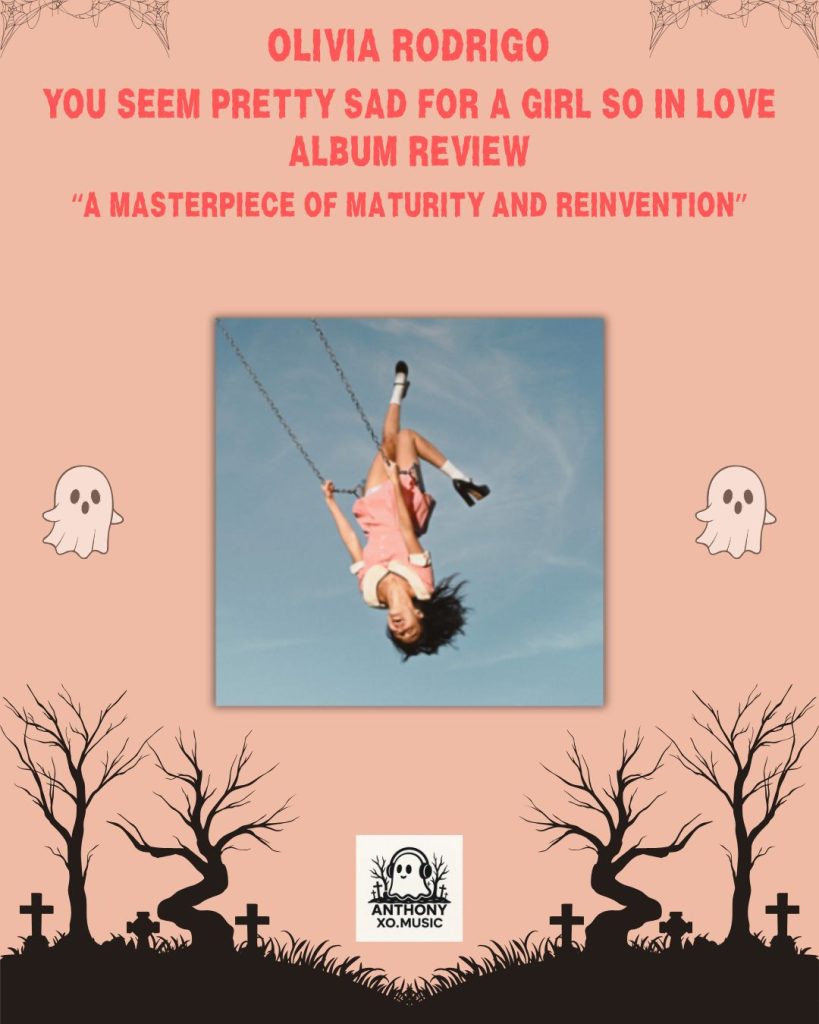
Olivia Rodrigo – You Seem Pretty Sad for a Girl So in Love Album Review: A Masterpiece of Maturity and Reinvention
For buying merch and Live Tickets, visit Olivia Rodrigo’s official website: https://store.oliviarodrigo.com/
It is genuinely fascinating to watch how the pop landscape behaves when a generational-defining force decides to completely tear up her own rulebook. After months of highly calculated rollouts, Olivia Rodrigo has finally returned with her third studio album, you seem pretty sad for a girl so in love, and it immediately demands that you throw out every single expectation you carried over from the SOUR and GUTS eras. Before this record even touched streaming services, I heavily predicted that this would stand as her absolute most mature and distinct body of work to date, and the final product completely validates that assumption. Olivia is no longer attacking her exes with the same teenage sarcasm, chaotic direct storytelling, and high-intensity, unhinged vocal performances that originally made her a household name.
Instead, this record tracks an immense artistic evolution, representing a massive structural shift away from her signature explosive pop-punk formulas and into an incredibly controlled, emotionally nuanced, and adult territory. That isn’t to say she has completely abandoned her roots—that raw, gritty, distorted sonic aggression is still fully intact on a handful of strategic tracks across the album—but the overarching architecture here leans into an entirely new level of restraint. A huge reason this stylistic gamble works so beautifully is that her creative partnership with producer Dan Nigro remains completely unbroken. Even though the core sound, textures, and pacing have radically transformed into something colder and more atmospheric, Nigro’s brilliant sonic fingerprints are all over these arrangements, proving their studio chemistry can survive any stylistic shift.
I was already fully on board for this new direction after falling completely in love with the two exceptional lead singles she dropped ahead of the release. In my opinion, “drop dead” was a masterclass in controlled, slow-burning synth-rock that felt incredibly refreshing compared to the distorted, radio-baiting lead singles of her past. Meanwhile, “the cure” delivered exactly what Olivia promised months ago—a deeply mature, organic, and heartbreakingly honest sad love song that anchors the emotional weight of this new era. This intro sets the stage perfectly for an album that isn’t just a collection of new songs, but a definitive, high-stakes declaration of who Olivia Rodrigo wants to be as a long-term artist.
The production architecture across this project is an undeniably sophisticated evolution from her previous works, trading chaotic, teenage distortion for something that feels like a polished, cinematic sanctuary. Once again, Olivia’s longtime collaborator Dan Nigro remains the primary architect behind the boards, but their chemistry has mutated into something far more adventurous and diverse than anything we’ve heard in her discography. While they haven’t completely killed off that classic pop-rock energy, they’ve meticulously crafted a new wave-inspired aesthetic layered with mellotrons, Moog bass, and sweeping, cinematic synths. The inclusion of the legendary Robert Smith of The Cure on the record only solidifies this shift, injecting a brooding, dark texture into the album’s veins. It creates an incredibly expansive arrangement that instantly elevates the record’s overall maturity.
What I appreciate most about this sonic palette is how it refuses to rely on one single, safe commercial lane. Instead, the tracklist behaves like a musically diverse playground, effortlessly shifting from organic, 1990s-style folk-rock acoustic production to sluggish chamber pop, right into her signature, vulnerable piano ballads. The loud, unfiltered, and highly distorted 2000s pop-rock sound that heavily channeled Paramore on her last two albums is almost entirely gone here. Instead of relying on a predictable formula, Olivia and Dan Nigro took some massive creative risks, opting for an instrumentation style that is grounded, mature, and deeply atmospheric. They absolutely nailed the execution on this, proving that Olivia can completely dominate a more refined sonic space without losing an ounce of her identity.
Songwriting-wise, this album marks a profound and necessary structural shift away from the external rage and venomous breakup anthems that defined Olivia’s previous eras. We all remember how she technically attacked her exes with sharp, mocking sarcasm, weaponizing unforgettable metaphors and direct lines across massive hits like “vampire,” “bad idea right?” and “get him back!” But on this project, those vengeful, outward-facing themes have completely dissolved into a deeply introspective, internal style of storytelling. The entire tracklist is built on a complex undercurrent of ironic self-awareness, perfectly capturing the essence of what is already being labeled a “Sad Lover Girl Summer.” Olivia has completely stepped away from amateur, surface-level insults to establish herself as an exceptional songwriter capable of brutal self-analysis.
Instead of pointing fingers or blindly blaming others for her heartbreaks, the lyricism here focuses on a much more mature realization: a partner cannot fix what is fundamentally broken inside her. She is trading her initial, reactionary instincts for a highly sophisticated level of introspection. This thematic journey splits the album into two distinct emotional waves: the opening phase, “girl so in love,” systematically examines the painful limits of forgiveness and the constant, exhausting struggles of maintaining a fragile relationship, whereas the closing phase, “you seem pretty sad,” functions as a heavy, haunting narrative of inner struggle and total surrender to the melancholy of infatuation. Ultimately, it is a massive step forward for her pen. Honestly, Louis Partridge should consider himself incredibly lucky that he didn’t end up on the receiving end of her signature sarcastic shots like the boyfriends who came before him.
The album kicks off with an elite-tier opening sequence, spearheaded by the stellar intro track “drop dead.” This song is a complete masterclass in controlled pop-rock production, managing to build immense tension without ever having to resort to harsh distortion or abrasive vocal straining. Sonically, it utilizes a slow-burning architecture that feels somewhat reminiscent of her historic debut “drivers license,” but the execution here is miles more intense, patient, and mature. The underlying production is beautifully minimalist but completely locked in, anchoring Olivia’s vocals with ridiculously amazing synth pads and delicate, warm elements of acoustic guitar. As our very first glimpse into this new era, I fell completely in love with the track, to the point where I formally recognized it as the single best song of April 2026 in my monthly wrap-up list. However, even with all its structural perfection, I still firmly believe there is another track later down the line that manages to outshine it.
That brings us directly to “stupid song,” which arrives right after to maintain the opening momentum. This track was recently teased by Olivia during the album rollout via a muted video clip of her shooting a music video on location in New York City, which she followed up yesterday by officially announcing that the visual would drop right alongside the album. To be entirely honest, the structural DNA of this track feels like the direct shadow of her 2023 blockbuster anthem “vampire.” Yet, instead of exploding into a theatrical, high-octane rock climax, it delivers its emotional payload through a mind-blowing, heavily controlled vocal performance. I will admit that when the chorus first hit, it felt like something I had already heard a thousand times before, and I’m still trying to figure out exactly why it triggered that specific sense of familiarity. Regardless, it is a damn good ballad; the seamless mixing of traditional piano with modern synths and acoustic guitar captures the exact atmosphere of “vampire” but repurposes it as a genuine, devastating sad love song rather than a sarcastic, vengeful ballad.
From there, the third track, “honeybee,” arrives to shift the temperature into far softer and colder territory. This song rarely ever reaches for high intensity, opting instead for a sonic palette that is visibly more delicate, fragile, and minimalistic compared to the two opening tracks. There is an organic, deliberate sadness baked into the core of this arrangement, and the way Olivia softly sings the first verse is so genuinely cute that it immediately disarms you. Rather than pushing the instrumentation into a harsher climate, the track relies on pure restraint, establishing a gorgeous acoustic lull that feels entirely earned.
The diverse palette of the record becomes even more apparent when you hit “maggots for brains,” which stands out as an incredibly eerie, left-field cut. The track leans heavily into a haunting, eerie new wave synth sound courtesy of Dan Nigro’s brilliant engineering. To be completely transparent, when I first hit play on this song, the quirky, underground texture of the synths made me feel like I was listening to a beat produced by my own friend in FL Studio. But as the song progresses, the exceptional metaphor of having maggots for brains brilliantly captures the terrifying reality of emotional decay, framing love not as a romantic fantasy, but as a literal, physical illness. Olivia executes this concept flawlessly, delivering a performance that I know will be incredibly effective for our generation, especially within her hyper-engaged, highly relatable core fanbase.
Olivia keeps the contemporary imagery rolling on “u + me = <3,” weaponizing a classic Gen Z text-message love metaphor to anchor a deeply moving track. The warm, intimate, and comforting production style immediately reminds me of the organic, bleeding-heart sadness found on the latest American Football album, which I heavily reviewed and praised last month. The rhythmic combination of a prominent, centerpieced Moog bass and crisp acoustic guitar creates an incredibly rich, organic, and melancholic atmosphere that completely pulled me in. From a pure engineering and production standpoint, this track is easily my absolute favorite on the entire album.
Unfortunately, that flawless streak hits a bit of an upsetting speed bump with the arrival of “my way.” This is a track where Olivia leans right back into the heavy sonic distortion and biting sarcasm that defined her previous records, which is a direction I honestly did not want to see her revisit on this specific project. I won’t go as far as to label it a bad song, because it isn’t, but the sonic maximalism and the self-worth metaphors feel a bit repetitive here—landing back into the exact same gritty, sarcastic lane that she already mastered and exhausted during her last two eras.
Luckily, the first phase of the album, designated as “Act 1: girl so in love,” concludes on a high note with the chiming folk-rock piece “purple.” This song is another excellent testament to the sheer diversity of the album’s musical palette. It doesn’t attempt to be a massive, over-produced radio single; instead, it functions as a highly interesting, nostalgic, and deeply intimate piano ballad that wraps up the emotional themes of the first act perfectly.
The record then crosses over into its second phase, “Act 2: you seem pretty sad,” which opens beautifully with the slow-burning banger “the cure”—a track that stands tall as my absolute favorite song on the entire project. This is the definitive moment where Olivia completely trades the cheap, sarcastic style of her older catalog for immense depth and introspective songwriting. Backed by an acoustic guitar-led indie rock production that eventually swells into a perfect, breathtaking orchestral explosion, the track is a flawless piece of art. Honestly, I tried my hardest to find a single flaw or misstep to critique here, and I simply couldn’t find a thing to blame. It is incredibly rewarding as a listener to see her finally reach this level of emotional maturity, executing a lyricism where she openly realizes that boyfriends can never be the cure when you are fundamentally broken deep inside your own soul.
That incredible peak makes the transition into “begged” feel a bit more grounded. I don’t have a massive, detailed breakdown to give for this track; quite simply, it’s just a good song. Olivia doesn’t necessarily push any new boundaries or thrive outside her comfort zone here, but she remains fully intact in her signature lane. The raw, vulnerable vocal performance ensures that the identity of the track remains 100% Olivia’s, proving she doesn’t need to rely on borrowed aesthetics to carry a tune.
Of course, the most anticipated moment on the tracklist for many will be the historic collaboration with the legendary frontman of The Cure, Robert Smith, who contributes his deep, iconic musical DNA to “what’s wrong with me.” The track carries a heavy, brooding metaphor of deep-seated psychological insecurity that feels totally relevant to the overarching narrative of the album. However, from a critical perspective, the actual sonic inclusion of Robert Smith alongside Olivia felt a little distracting to me, pulling my focus away from her vocal narrative. Even with that slight distraction, the dark, gothic-tinged track is fully there and delivers a haunting atmosphere that is hard to ignore.
The eleventh track, “less,” slows things down significantly, utilizing a sacrificing relationship metaphor wrapped in a sophisticated, wine-bar piano-style production. Lyrically, she is showing a profound sense of emotional exhaustion, restraining her own expectations and actively choosing to want less out of the relationship simply because she is tired of being overly ambitious and constantly getting her heart broken. While I wouldn’t necessarily flag this specific cut as an album standout, it remains a very solid, mature addition to the tracklist.
Admittedly, I nearly fell completely asleep during the quiet, slow-burning piano balladry of “less,” but any lingering drowsiness was instantly shattered when the final, roaring maximalism of “expectations” woke me right back up. This track is another absolute acoustic guitar-driven banger that deals aggressively and head-on with the stinging disappointment of failed relationships. The beauty of the songwriting here lies in the accountability; she isn’t pointing fingers or blindly attacking others for her misery. Instead, she is looking inward, blaming herself for the unrealistic weight of what she expects versus what she actually receives from a partner. That is a massive, enlightened realization—not a reactionary attack.
The album reaches its definitive conclusion with “cigarette smoke,” an absolute epic of a finale that clocks in as the longest track on the entire project. There are already several industry sources online speculating that the lyrics might be taking a subtle shot at Louis Partridge, which is certainly a possibility, though I can’t sit here and confirm it as absolute fact. Regardless of the gossip, I am completely obsessed with the production and the grand arrangement of this closer. It is entirely evident that Olivia treated this finale as something incredibly special and opulent, pulling out all the stops to decorate the track with a crazy, cinematic arrangement of Mellotron, grand piano, and sweeping dramatic strings, bringing the entire record to a breathtaking end.
Ultimately, you seem pretty sad for a girl so in love is a definitive, career-defining triumph that proves Olivia Rodrigo is a generational force capable of completely reinventing herself. This record marks an immense structural shift in her style, stepping away from the predictable pop-punk tropes to thrive in a much more sophisticated, atmospheric sonic landscape. What makes this project stand out so brilliantly is the absolute lack of filler across the 13 tracks; every single song feels entirely necessary and meticulously crafted. Her growth as a writer is undeniable, trading reactionary, surface-level sarcasm for deep, introspective storytelling and mature emotional accountability. By shedding the heavy influences of Paramore or Avril Lavigne that anchored her earlier eras, she has delivered a body of work that sounds completely like Olivia Rodrigo and nobody else. It is a musically adventurous, emotionally bruising masterpiece that sets a massive new standard for contemporary pop music.
[Rating: 9/10]
- Favorite Tracks: drop dead, stupid song, honeybee, maggots for brains, u+ me = <3, purple, the cure, begged, what’s wrong with me, less, expectations, cigarette smoke
- Least Favorite Tracks: my way
Read more reviews: