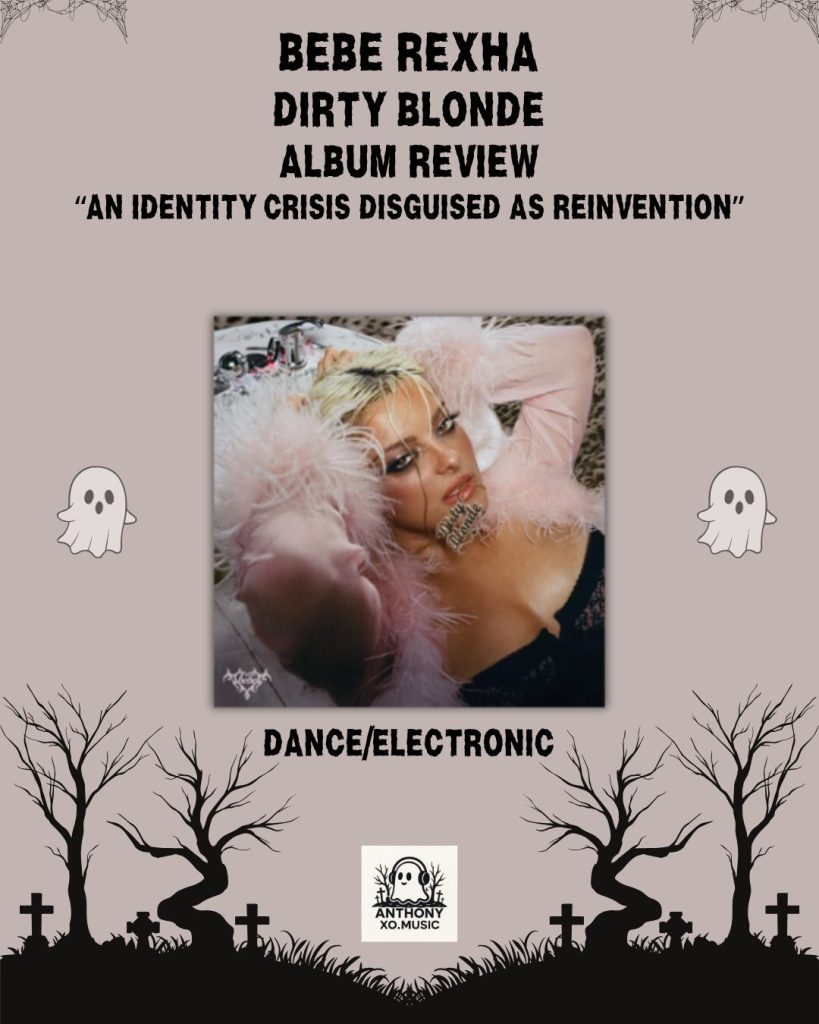
Bebe Rexha- DIRTY BLONDE Album Review: An Identity Crisis Disguised as Reinvention
For buying merch and Live Tickets, visit Bebe Rexha’s official website: https://beberexha.com/
It is a bizarrely consistent phenomenon in modern pop to witness artists who occupy the upper echelons of the charts but fail to leave even a microscopic footprint on the broader cultural landscape. Bebe Rexha is the absolute blueprint for this anomaly; much like Charlie Puth, she is a standard-issue hitmaker boasting massive, multi-platinum smashes like “Meant to Be” and “I’m Good (Blue),” yet she has never managed to carve out a definitive artistic identity or a lasting musical legacy. While I have always respected her knack for landing radio-conquering hooks, I have simply never been a fan.
Now, marking her very first full-length effort since departing from her long-standing major label home at Warner Music, she returns with her fourth studio album, DIRTY BLONDE. Marketing teams have heavily pushed this project as a 13-track visual album experience, but as a self-proclaimed, pure audio-streaming holic, I frankly couldn’t care less about the accompanying videos. What immediately caught my attention instead was the sheer chaos of the rollout itself—she essentially leaked her own record by aggressively dropping so many singles beforehand that the tracklist felt almost entirely spent before arrival. It represents a massive, high-stakes gamble for an artist of her pedigree, attempting to radically fuse pop, country, hip-hop, and industrial dance-pop into a singular space. By actively forcing the “old” and “new” sonic versions of herself to collide, the baseline expectations for this record were already set to a volatile, unpredictable frequency.
The production architecture across DIRTY BLONDE completely shatters any illusion of independent artistic integrity. Despite loudly celebrating her exit from Warner Music, Bebe Rexha inexplicably recruited an overcrowded army of 29 different producers—including radio-chasing giants like DJ Snake and David Guetta. This isn’t a bold statement of creative liberation; it is the sound of an artist desperately craving mainstream attention over establishing a unique identity. Sonically, the arrangement is a bloated, brain-melting nightmare for anyone who values consistency and smooth transitions. The tracklist aggressively jerks the listener from cheap, generic club disco beats directly into jarring hip-hop textures with total disregard for cohesion. Attempting to anchor a deeply emotional summer theme while simultaneously forcing pop, country, hip-hop, and aggressive club elements to collide feels like a suicide mission—a challenge as impossible as defeating the USA in a war on their own soil. It fails on every metric of engineering logic.
Songwriting-wise, Bebe Rexha remains exactly what she has always been: a safe, generic writer desperately chasing mainstream attention with cheap hooks rather than expressing who she truly is. The entire project is bloated and completely lacks cohesion, offering zero memorable or strong writing. Instead, she relies heavily on agonizingly lazy, repetitive hooks like “Like nobody’s there, there, there, there, there,” “I’m the shit, I’m the shit,” and “Got a kiss from a girl in Tokyo / Where did she come from? I don’t know.” It is the same uninspired formula I found on the latest Labrinth album—except that record actually featured great verses, while Bebe couldn’t bother to nail those either.
Dive into the actual tracklist, and the illusion of an independent rebirth immediately evaporates. The first two tracks are the same generic, radio-friendly EDM bangers she has coasted on for her entire career. While they aren’t technically terrible, there is absolutely nothing here that pushes beyond her comfortable, formulaic world, and I simply cannot stand behind music that safe. They are completely unexceptional.
That predictability bleeds right into “New Religion.” While the EDM production here is undeniably crisp, it refuses to step outside her usual territory. Instead, it plays out like a desperate attempt to recreate the safe, radio-friendly energy of “I’m Good (Blue),” leaning heavily on a completely basic hook: “I feel the beat, I feel the beat, it’s like a new religion.” But the real identity crisis hits with “$.H.I.T.” When this track started, I genuinely thought I was listening to Doja Cat because Bebe completely alters her vocal delivery out of nowhere. Then, she pivots into rapping at an Ice Spice level, which is just pure goofiness. I respect versatility, but when you are taking a Mount Everest-sized creative risk just to deliver amateur-hour rapping, you deserve to get criticized for it.
I will throw a shred of respect to “Çike Çike” solely because she takes the time to honor her Albanian roots. However, since I don’t understand a word of what she’s singing, I’m not going to stress my mind trying to unpack it.
Any goodwill is instantly destroyed when she runs right back to the clubs with the same exhausted, aggressive beats. “i like you better than me” shares the same lazy DNA as the opening three tracks, and the repetition becomes genuinely annoying.
That brings us to the ultimate bait-and-switch: “Drink And A Little Love.” The track opens with an acoustic guitar-driven country vibe. Despite a terribly awkward transition from the previous club record, I actually started to praise her because I’ve been heavily in love with female country music all year. I thought she was finally about to nail a deeply emotional country cut—until the production tricked me. Out of nowhere, the song violently switches right back into cheap disco territory. It completely kills the song’s emotion and makes me forget it even had country elements to begin with.
The following two tracks, “One Day” and “Time,” attempt to offer emotional resonance through acoustic production, but they fail to stand out beyond decent filler. Then comes “Nobody’s There,” which pairs generic club production with a narrative that essentially tells you to celebrate your isolation by hitting the dance floor. I’m sorry, but I don’t handle isolation like that.
The album reaches its definitive conclusion with the David Guetta-assisted closer, “Sad Girls.” It is painfully obvious that she wanted to replicate the exact DNA and commercial lightning of “I’m Good (Blue),” but paired with such generic writing, the finale lands with a total thud—leaving the project completely unmemorable and unimpactful.
Ultimately, DIRTY BLONDE stands as a definitive, career-stalling misfire that utterly squanders its own narrative of independent liberation. Bebe Rexha set out to conquer a massive, multi-genre landscape, but by forcing conflicting sonic identities into the same bloated space, the project completely implodes under its own weight. It functions much like World War II history—a high-stakes, reckless gamble that completely miscalculated the landscape and resulted in a total, catastrophic devastation. There is absolutely nothing here that steps beyond her safest, most predictable commercial territory. Weak writing and agonizingly generic hooks completely hollow out whatever emotional weight she intended to convey, leaving behind a disjointed collection of club tracks entirely devoid of genuine artistry. By prioritizing mainstream radio bait over building a cohesive, definitive musical legacy, she has delivered a project that is an absolute chore to endure front-to-back. It is a toothless, lazy, and utterly uninspiring record that firmly solidifies itself among the absolute worst albums I have heard all year.
“DIRTY BLONDE is a high-stakes sonic gamble that completely implodes under its own weight, trading genuine artistic growth for lazy writing and generic club tracks.”
[Rating: 2/10]
- Favorite Tracks: New Religion
- Least Favorite Tracks: $.H.I.T, i like you better than me, Drink A Little Love, Nobody’s There, Sad Girls
Read More Reviews: