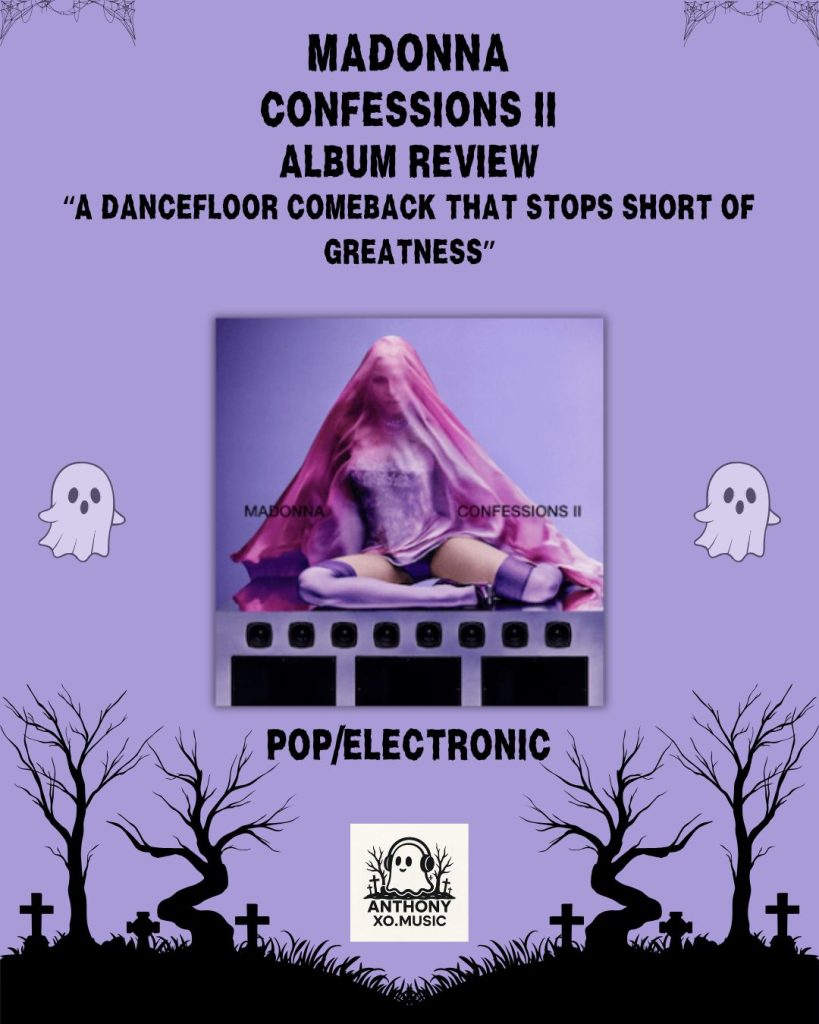
Madonna – CONFESSIONS II Album Review: A Dancefloor Comeback That Stops Short of Greatness
For buying merch and Live Tickets, visit Madonna’s official website: https://www.madonna.com/
The Queen of Pop is officially back with her signature dancefloor vibes, but my journey into this record didn’t start with praise. Initially, I completely hated the trajectory of this album cycle when she dropped the lead single “Bring Your Love” featuring Sabrina Carpenter back in April. The track left such a bad taste in my mouth that I fully intended to completely roast the album the second it officially dropped.
Instead, I feel absolutely tricked after actually sitting down and listening to the full project. Marking her first full-length return since 2019’s experimental Madame X, this massive 16-track effort spans over an hour of runtime. Madonna expands her sonic universe by collaborating with an eclectic roster including Sabrina Carpenter, Feid, Martin Garrix, and Stromae.
Together, they lean heavily into a flawless fusion of 90s dance-pop, high-energy EDM, and deep house elements that completely subverted my expectations. Therefore, I’d say that the “Dancefloor” isn’t dead yet. I was genuinely surprised to see how Madonna performed these songs, delivering a level of vocal energy and stamina that made it sound like she was still in her 30s. That pure performance factor surprised me more than anything else here.
Still, I view CONFESSIONS II as a positive comeback, but definitely not a triumphant return. The production is completely based on those infectious dancefloor vibes, but because it is a massive 16-track record, the sonic palette inevitably begins to feel partially monotonous as the runtime goes on. We may love dancing to it right now, but I don’t think it will actually remain stuck in our heads throughout this year.
Ultimately, I couldn’t find a single iconic, memorable beat on this album like “Hung Up” that has the power to dominate the sound of the internet for years to come.
As I just mentioned, the production on this album isn’t weak at all; in fact, I’d say it is perfect in the common sense. For this project, she reunites with Stuart Price, who was the legendary architect of the original Confessions on a Dance Floor back in 2005. Unlike her last album, Madame X, which was wildly experimental, this record serves as a strategic stabilizer, riding nostalgic dance-pop DNA alongside 2026 production standards to ensure absolute brand consistency.
By utilizing Price’s signature synth-wave energy, Madonna successfully creates a strong sonic barrier against the “static” minimalism that has been trending throughout the mid-2020s.
That is certainly a positive achievement, but it also means she was actively chasing trends just to revive her dancefloor era—something I don’t particularly like to see from an established legend like her. When I initially played the first few tracks, the production seemed incredibly slappy and punchy. However, that excitement soon gave way to a pretty monotonous feeling because the beats weren’t changing enough, choosing instead to just flow strictly in the same sonic lane for a long stretch of the runtime.
Fortunately, that tedious feeling didn’t last all the way to the end, as I noticed some really good, refreshing beat switches finally kicking in during the last couple of tracks on the album.
I think Feid and Martin Garrix gave solid features with their signature styles. I don’t have too many things to say about Martin Garrix because he didn’t go far beyond his territory here, but I really enjoyed the acoustic guitar elements blended with the dance beats on the track “Read My Lips” featuring Feid.
Now, coming into the songwriting, Madonna is still operating in her signature style, just like she was in her prime years. Yes, I do think that this album features very mature writing, if not a total masterclass, and you should absolutely expect that from an established 67-year-old legend like Madonna.
But one thing that disturbed my mind is that this album also has highly repetitive lyrics, especially across the hooks. If you have ever read my reviews, you may already know that I hate that thing so much. I do think that’s kinda okay since it’s a dance-pop album where the groove takes center stage.
Still, I’m not loving that specific narrative, but I’m also not trying to fire too many direct shots here because I’m recently suffering from slamming Bebe Rexha for weak songwriting and repetitive hooks on her recent projects.
The album opens with the track “I Feel So Free,” and initially, I used to hate this song when it first dropped. But over time, my opinion completely changed, and I am really liking this track now. The song starts with slow-burning beats and Madonna’s minimal vocals. Honestly, I was not loving it at all until the chorus came out and made me immediately think about her astonishing 90s era.
Surprisingly, her vocals don’t sound like a 67-year-old at all here; I don’t even know how she does that.
I also loved the track “Love Without Words” because this specific song dragged me right out of that monotonous feeling I was experiencing around that point in the runtime. The deep EDM house vibes instantly give you a euphoric feeling, and it is also ideal for current electronic trends.
Meanwhile, the track “Fragile” gave me some serious prime Madonna vibes, closely echoing her iconic “True Blue” era. I was so amazed to see how Madonna sounded so much like her prime self. This is undoubtedly my favorite song from the entire album. This track is also incredibly special because Madonna described the songwriting as a cathartic release about her brother, who passed away in 2024.
On the other hand, I still couldn’t bring myself to like one particular song here, and that’s “Bring Your Love” featuring Sabrina Carpenter. Overall, I just don’t think it’s for me, and I’d never like it personally. The production itself is somewhat solid, and Sabrina’s verse is also pretty good, but as a lead single, it simply doesn’t have that essential replay value.
Ultimately, Madonna’s Dance Floor isn’t dead, but it is also partially boring. Confessions II successfully serves as a positive, strategic comeback that stabilizes her brand after the experimental wild turns of Madame X. Rejoining forces with Stuart Price allows her to channel nostalgic 90s dance-pop and house aesthetics, creating a polished shield against the static minimalism dominating today’s music scene.
More than anything, her vocal stamina is mind-blowing—delivering an energetic performance that completely defies her 67 years and echoes her absolute prime on tracks like “Fragile.”
However, the album is severely weighted down by its massive 16-track runtime, causing the middle section to bleed into a monotonous blur of repetitive lyrical hooks and unvarying rhythms. While guest appearances from Feid and late-album sonic shifts keep the project afloat, it lacks that singular, culture-defining anthem required to cement this as a truly triumphant return.
It is an incredibly fun club record for right now, but it ultimately fails to deliver the timeless, inescapable magic needed to dominate the internet for years to come.
[Rating: 6/10]
- Favorite Tracks: I Feel So Free, Good For The Soul, Love Without Words, Bizarre, Fragile, Betrayal
- Least Favorite Tracks: Bring Your Life, School, The Test
Read More Reviews: